Fermilab Quantum Computing 2025
In addition to being one of the top particle physics and accelerator research facilities in the world, the U.S. Department of Energy’s Fermi National Accelerator Laboratory serves as a major innovation hub for DOE’s objectives of advancing cutting-edge fields like artificial intelligence and quantum information science. Through significant new findings, fascinating partnerships, and advancements on crucial projects that support Fermilab’s future as the world’s center for neutrino research, the lab’s ambitious team of scientists, engineers, technicians, and operations personnel advanced the lab’s scientific mission throughout the year.
You can also read Chris Wright Viewed Fermilab’s LBNF DUNE Neutrino Project
Fermilab Highlights Significant Developments in 2025 in Quantum Science
With a number of significant achievements in quantum information science (QIS) in 2025, Fermi National Accelerator Laboratory (Fermilab) solidified its position as a preeminent U.S. research center for cutting-edge technology. By holding national events, building new facilities, and maintaining strategic alliances with business and government, the lab expanded its quantum research portfolio all year long.
Fermilab’s dedication to developing quantum computing, networking, and sensing technologies—fields that hold the potential to revolutionize computation, measurement, and materials research for many years to come—lays the foundation for these initiatives.
Examining the Symposium on the Quantum Universe
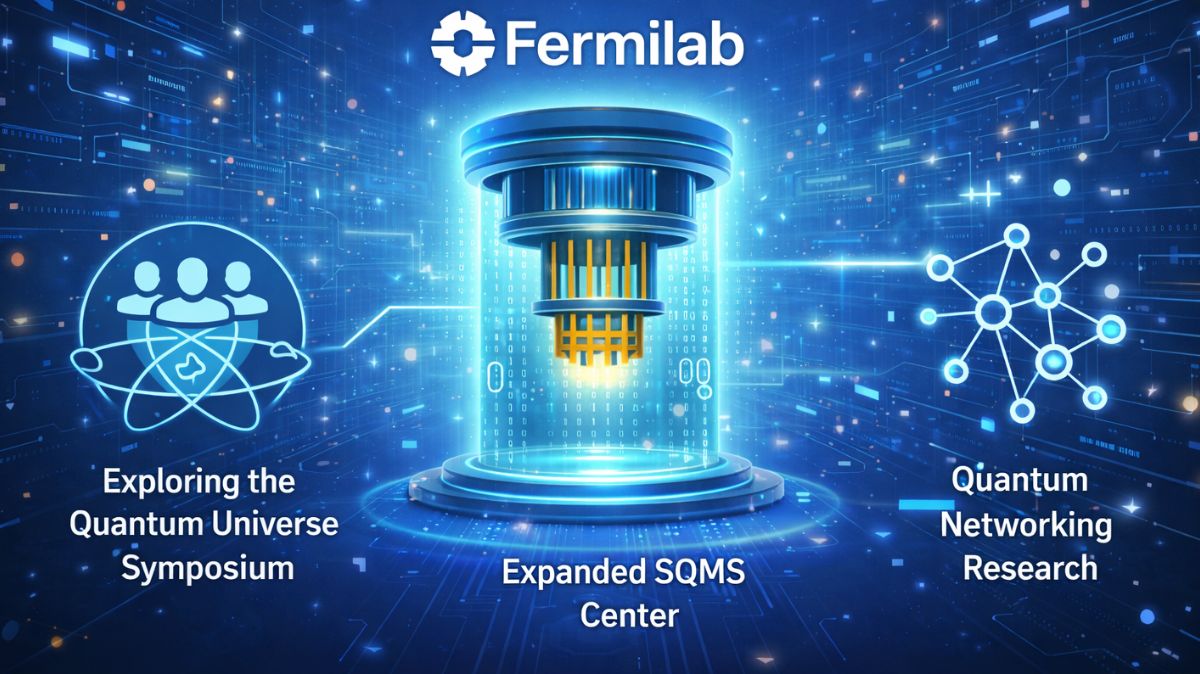
A nationwide symposium called “Exploring the Quantum Universe” was held at Fermilab in early December, bringing together specialists from all over the US quantum research community. The event promoted cooperation between academic institutions, national laboratories, and the private sector while showcasing state-of-the-art advancements in quantum technologies. Applications of QIS in fundamental physics and real-world difficulties in scaling quantum technology were among the topics covered.
The symposium was in line with larger federal initiatives to keep the United States at the forefront of quantum science and innovation, according to Fermilab feature coverage. The lab used its extensive knowledge of superconducting systems and particle physics to help connect basic research with new quantum applications.
You can also read Southeastern Quantum Collaborative(SQC) Launched By UAH
Extension of the SQMS Center with DOE Assistance
The ongoing expansion of the Superconducting Quantum Materials and Systems (SQMS) Center, a DOE National Quantum Information Science Research Center housed at Fermilab, was a significant feature of 2025. To accelerate advancements in quantum computing, communication, and sensing technologies, DOE extended funding for SQMS in November, allocating $125 million over five years.
Fermilab’s proficiency in superconducting radio-frequency (SRF) technologies, which were initially created for particle accelerators, is leveraged by the SQMS Center. In order to create scalable and highly coherent quantum systems, these SRF systems are now being modified and enhanced for quantum information processing.
SQMS leaders emphasize that this increased funding will help progress integrated quantum devices, scalable cryogenic infrastructure, and ultra-high coherence qubits—all essential elements for useful quantum computer systems. Additionally, the center’s work aligns with worldwide endeavors to construct quantum networks that can link sensors and processors.
You can also read Microsoft PQC ML-KEM, ML-DSA algorithms for windows & Linux
Overcoming the Barrier of Coherence
The demonstration of superconducting multimode qudit platforms with coherence times longer than 20 ms was one of the year’s most important technical accomplishments. “Qudits” can exist in numerous states, exponentially expanding the computational space, in contrast to normal qubits, which only have two states (0 and 1).
The longest-lived superconducting quantum processor unit yet constructed was made by Fermilab scientists using ultra-high-coherence 3D superconducting radio-frequency (SRF) cavities, which were first developed for particle accelerators. One of the main “noise” obstacles in the business is addressed by this architecture, which provides increased connection and decreased control complexity.
You can also read Exploring Quantum Spin Liquids Through the Kagome Lattices
A Massive Telescope for the Tiniest Signals: MAGIS-100
Additionally, Fermilab commemorated the completion of the laser laboratory for MAGIS-100, the largest vertical atom interferometer in the world. This cutting-edge quantum sensing equipment, which is housed in a 100-meter access shaft, is intended to pick up the “tiniest signals” from the universe’s furthest reaches.
Using cold atoms as quantum sensors, MAGIS-100 looks for:
- Finding extremely light candidates that are undetectable to conventional detectors is known as “dark matter.”
- Observing spacetime ripples in a frequency range that is currently unavailable to other experiments is known as gravitational waves.
- Testing the basic boundaries of quantum mechanics at vast scales is known as “New Physics.”
The QICK Platform and Strategic Alliances
The DOE partnered with Fermilab and Qblox to produce and market the Quantum Instrumentation Control Kit (QICK) in order to guarantee that these innovations are made available to the commercial sector. A fundamental tool for managing quantum bits, this open-source platform was created at Fermilab and is currently being expanded to accommodate thousands of qubits in a single system.
Wide-ranging Effect on the Quantum Ecosystem
Beyond just specific technologies, Fermilab’s quantum efforts support public involvement, workforce development, and inter-institutional collaboration. Organizing significant symposiums such as Exploring the Quantum Universe fosters communication across government, business, and academic sectors. The U.S. National Quantum Initiative’s national QIS goals, which aim to speed up technological development and commercialization, are in keeping with this integrated strategy.
Furthermore, Fermilab’s involvement in quantum computing, sensing, and networking initiatives is a component of a broader portfolio that also includes collaborations with private companies, other national labs, and foreign partners. These collaborative initiatives seek to overcome significant obstacles in the design of quantum hardware, error correction, and system scalability.
You can also read QMCkl: High-Accuracy Quantum Monte Carlo Simulations
Gazing Ahead
It is anticipated that Fermilab’s quantum research will continue to advance as it moves towards 2026. Fermilab is well-positioned to contribute to discoveries that could transform both basic research and cutting-edge technologies with increased federal backing, bigger financing commitments, and a more involved scientific community.
Fermilab’s achievements in 2025 demonstrate a deliberate effort to influence the direction of quantum information science, from organizing national symposiums and developing quantum system architectures to growing interdisciplinary partnerships.
You can also read High-Purity Photon Pairs Could Power Quantum Internet



Thank you for your Interest in Quantum Computer. Please Reply