IBM Osprey
As one of the most potent quantum processors ever created, IBM’s Osprey quantum processor is a major turning point in the development of large-scale quantum computing and highlights the company’s ambitious plan for useful quantum systems.
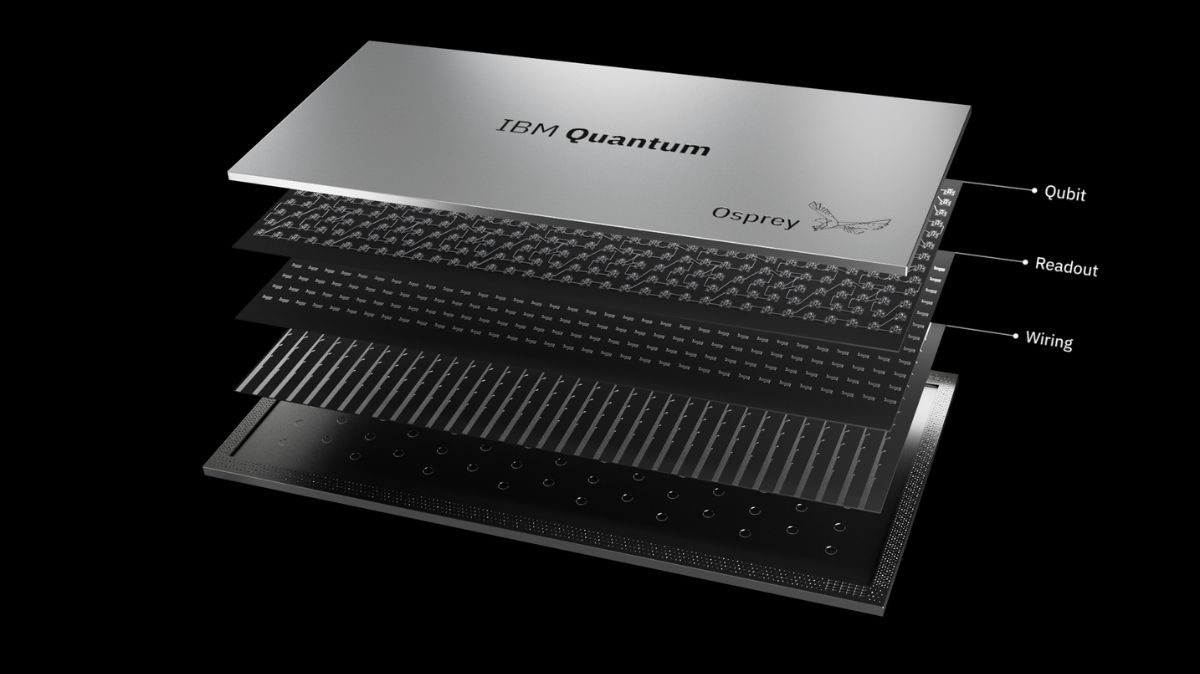
The Osprey processor, which debuted at the IBM Quantum Summit in November 2022, has 433 qubits—more than three times as much as its predecessor, the IBM Eagle device, which had 127 qubits. When Osprey first came out, it was the biggest quantum processor in IBM’s portfolio and among the most sophisticated in the world.
You can also read Fermilab Quantum Computing Research Drives 2025 Innovation
Osprey Importance
Quantum computing’s fundamental building block is a qubit, or quantum bit. Because of quantum superposition, qubits can exist in numerous states simultaneously, unlike classical bits that only represent 0 or 1, enabling quantum computers to explore incredibly huge computational areas. The ability to solve complicated issues that are outside the scope of conventional theory increases significantly as more qubits are coupled.
Osprey, which has 433 qubits, is made to go beyond those boundaries. A state’s information capacity on this processor may be so large, according to IBM, that it would take more bits to represent it classically than there are atoms in the universe. Although there are currently no real-world applications for this size, it is a first step towards quantum advantage, the ability of quantum devices to perform better than classical supercomputers on particular tasks.
You can also read Quantum Anticode: A New Concept In Quantum Error Correction
Features and Design of Technology
To maintain quantum coherence and reduce noise, Osprey uses superconducting transmon qubits that are cryogenically cooled to about 0.02 Kelvin, which is just above absolute zero.
Progress in multi-level wiring and integrated filtering, techniques that assist lower signal noise and enhance qubit stability and performance—both essential for scaling up quantum hardware—was also emphasized by IBM’s engineers.
You can also read Hybrid Excitons: A Quantum Leap for Solar Technology
Osprey on the Roadmap to Quantum
On IBM’s long-term quantum plan, Osprey represents a crucial checkpoint rather than an endpoint. IBM plans to introduce even larger processors after Osprey’s debut:
- Condor: A 1,121-qubit processor designed to surpass the 1,000-qubit limit and conduct additional performance and system integration testing.
- Kookaburra and beyond: According to IBM’s strategic planning, by 2025, systems with hundreds of qubits put together using modular and multi-chip architectures could be possible.
IBM’s larger goal of creating quantum-centric computing, in which quantum processors combine with classical systems to build hybrid supercomputers that can solve optimization, materials science, cryptography, and machine learning problems at previously unattainable scales, is reflected in the roadmap.
You can also read Samsung and SK Hynix: Shaping Korea’s Tech-Driven Future
Hardware and Software Linking
IBM is also developing its software stack, which includes tools like Qiskit—an open, community-driven software platform that enables people to create quantum algorithms and run them on actual processors in the cloud—because scaling up qubits alone is insufficient for realistic workloads.
In order to enable developers to start prototyping real-world applications even while hardware continues to grow, the company’s strategy attempts to link software and hardware advancements.
You can also read QMCkl: High-Accuracy Quantum Monte Carlo Simulations
Practical Consequences
Even though a 433-qubit processor like Osprey might not yet be strong enough to surpass classical supercomputers in every task, its development demonstrates the quick advancement of quantum engineering and portends a change towards devices that can solve challenging scientific problems, optimize international logistics, and contribute to advances in material science and cryptography.
These developments also support more general trends in industry and research, where it is anticipated that quantum systems will have an impact on fields like cybersecurity. This is particularly true as quantum computers become strong enough to challenge current encryption standards, which will spark interest in “post-quantum” cryptographic techniques.
You can also read Rigetti Computing vs IonQ Comparison: Differences Explained
In Brief
IBM’s Osprey quantum processor, which has 433 qubits and is among the most ambitious processors yet built, is a landmark in the field of quantum computing. It represents IBM’s ambitious quantum strategy and continuous efforts to build the foundation for genuine quantum-enabled computing in the next years by fusing software and hardware innovation.



Thank you for your Interest in Quantum Computer. Please Reply