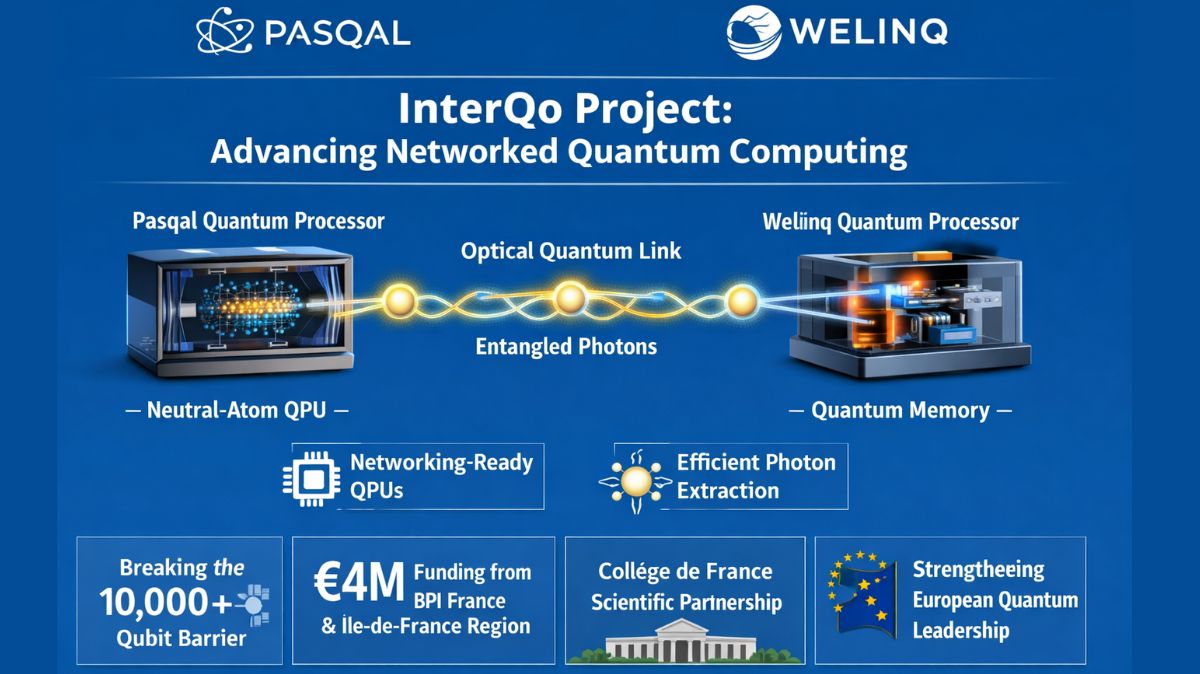
The announcement of a significant extension of their strategic partnership by French quantum giants Pasqal and Welinq marks a paradigm leap for the quantum business. The goal of the collaboration is to hasten the shift from standalone quantum machines to networked, interconnected quantum structures. The centerpiece of this effort is InterQo, a well-known project supported by €4 million in funding from BPI France and the Île-de-France Region as part of the “i-Demo Régionalisé” program for France 2030.
This partnership brings together two of the leading quantum technology companies in Europe to tackle the most important issue facing the field: scalability. Even while quantum processing units (QPUs) of today are already providing useful applications, researchers predict that individual computers will soon reach their physical limits. To overcome these obstacles and open the door for production-ready systems in international data centers, Pasqal and Welinq plan to connect several processors to work as a single, enormous computing engine.
You can also read Aramco Pasqal Partnership Brings 200-Qubit Quantum System
Breaking the 10,000-Qubit Barrier
To date, the deployment of quantum resources has largely relied on standalone QPUs. It is anticipated that around about the 10,000 physical qubit threshold, vertical scalability the capacity to add more qubits to a single processor will face major challenges for neutral-atom systems.
Through quantum networking, the InterQo project suggests a horizontal solution. Photons are the “ideal carriers of flying quantum information” in this paradigm, which transforms quantum information from stationary qubits inside a QPU. These photons are then sent from one processor to another via optical transmission. This optical quantum connection essentially creates a “larger quantum computer with many more qubits than any individual machine could provide” by enabling the sharing of entanglement across different QPUs.
Large-scale, fault-tolerant quantum computation requires increasingly sophisticated quantum algorithms, which the industry can provide by networking several units. To guarantee that quantum computing can satisfy the requirements of advanced materials discovery and artificial intelligence, this change is not just theoretical; rather, it is an essential evolution.
A Shared Technological DNA
“Shared neutral-atom technology stack” is the foundation of the relationship. Working at the same optical wavelengths, Pasqal and Welinq independently create natively compatible technologies. From the networking protocols that link them to the hardware layer of the QPU, this technical alignment streamlines the integration process.
An industry leader with production plants in Canada and France, Pasqal, supplies the core computing architecture. In addition to locations in Saudi Arabia and Canada, the company has already set up functional QPUs at high-performance computing (HPC) facilities throughout Europe, such as CEA in France, Jülich in Germany, and CINECA in Italy. With its customized vacuum chambers that combine photonic interfaces while preserving the ideal conditions needed for quantum processes, Pasqal’s most recent QPU designs are “natively compatible” with networking. To enable variable coupling between qubits and the network interfaces, they additionally make use of dynamical qubit location.
Welinq delivers the vital “connective tissue” that these systems require. Their main invention is a waveguide-QED-based high-rate entanglement generating platform that effectively serves as a “quantum Ethernet port.” This enables large rates of entanglement sharing among QPUs. In addition, Welinq recently recorded its first commercial sale and proved the most potent neutral atom-based quantum memory to date, which is an essential part of buffering quantum information.
You can also read France’s Plan Quantique Develops Cat Qubit Chip Production
The InterQo Milestone
This common vision’s “concrete execution” is exemplified by the InterQo project. Beyond the corporate sector, the program involves a focused scientific partnership with the group of renowned quantum optics expert Alexei Ourjoumtsev at Collège de France (JEIP).
Two main technological obstacles are the project’s focus:
- Networking-Ready QPUs: Quantum processors that are designed from the ground up with integrated networking capabilities.
- Photon Extraction: To connect the QPU to the larger network, photons must be extracted using extremely effective techniques.
Pasqal’s CEO, Loïc Henriet, stated that although the company has working machines all around the world, integrating them into “networked quantum clusters” is the next big obstacle. The “essential groundwork” for this transformation was laid by the InterQo program, he said.
Strengthening European Sovereignty
Beyond the technological achievements, the Pasqal-Welinq collaboration benefits the European quantum ecosystem strategically. These innovative capabilities were “developed on European soil,” according to both corporations, which helped the continent become a leader in technology and create high-value jobs.
This partnership also fits in with larger industry projects like Q-PLANET, a Pasqal-led effort that Welinq is a major partner in that aims to scale the quantum technology supply chain throughout Europe. With regard to cutting-edge laser technologies, the businesses also have established relationships with other industry titans like Exail.
Welinq CEO Tom Darras was upbeat about the collaboration’s prospects, saying, “Combining neutral-atom computing and quantum networking brings us one step closer to the deployment and commercialization of interconnected quantum computers in data center environments, globally.”
Pasqal and Welinq’s InterQo project is constructing infrastructure today that will serve as the foundation for the next generation of quantum-ready data centers as quantum computing advances into production-scale systems.
You can also read Pasqal’s Neutral-Atom QPU On Google Cloud Marketplace
Thank you for your Interest in Quantum Computer. Please Reply