Bell-State Generation
Innovative Loss-Tolerant Qudit Protocol Releases Parallel Bell-State Generation, Sparking Aspirations for Quantum Networks During an Investment Boom
Researchers Z. M. McIntyre and W. A. Coish have uncovered a new loss-tolerant qudit protocol that can create many entangled particle pairs, or Bell pairs, in concurrently, marking a major advancement in quantum communication.
The ongoing problem of photon loss in quantum information transmission is directly addressed by this novel approach, which is a significant step towards building resilient quantum networks and distributed computing systems. The disclosure comes during a thriving time for the quantum industry, marked by significant investment and quick technological advancement.
The method, described in “Loss-tolerant parallelized Bell-state generation with a hybrid cat qudit,” makes use of an advanced hybrid quantum system that cleverly encodes quantum information in matter and light. This method’s use of Schrödinger’s cat states to encode a qudit is essential. This sophisticated encoding is essential for detecting and correcting photon loss during transmission, a significant barrier that can deteriorate delicate quantum data. In contrast to a classical bit, a qudit is a quantum digit that can exist in more than two states.
Revolutionizing Error Correction and Parallelization
This novel method’s intrinsic error-resilience is one of its most notable features. Through the use of supplementary qubits to entangle the light pulse, the system enables the immediate detection of missing photons. By detecting any lost photons, subsequent measurements of these auxiliary qubits serve as a parity syndrome, allowing for deterministic error correction via single-qubit rotations.
The created entanglement’s fidelity is guaranteed by this method, which is essential for realistic quantum communication. According to the researchers’ calculations, this cat-state encoding is more resilient to qubit dephasing and photon loss than typical phase-based encoding, with the quality of entangled states deteriorating more slowly as photon loss rises.
Apart from its strong error correction, the protocol’s ability to generate Bell pairs in parallel is exceptional. This allows for the simultaneous entanglement of several quantum registers by encoding information within the period of a coherent light pulse. A single light pulse can entangle several qubits, which is made possible by the qudit’s multi-level structure.
Comparing this parallelized approach to sequential entanglement schemes which frequently require delay lines and consume communication channels for durations dependent on the number of entangled pairs reveals significant efficiency improvements. The communication channel between qubits in circuit quantum electrodynamics (cQED), for instance, is occupied for a duration that is independent of the number of entangled pairs formed. This offers significant benefits for effective scheduling and synchronization across complicated quantum devices.
Coherent light sources, quantized cavity modes, coupled qubits, and heterodyne detection to determine the light pulse’s phase are all part of the experimental setup for this approach. Implementing the required entangling operations requires careful management of the interaction between qubits and their cavities. Due to its great adaptability and compatibility with both optical and microwave technology, the protocol can be used in a variety of quantum systems, including the microwave-regime cQED, in the near future.
Laying Foundations for a Quantum Internet
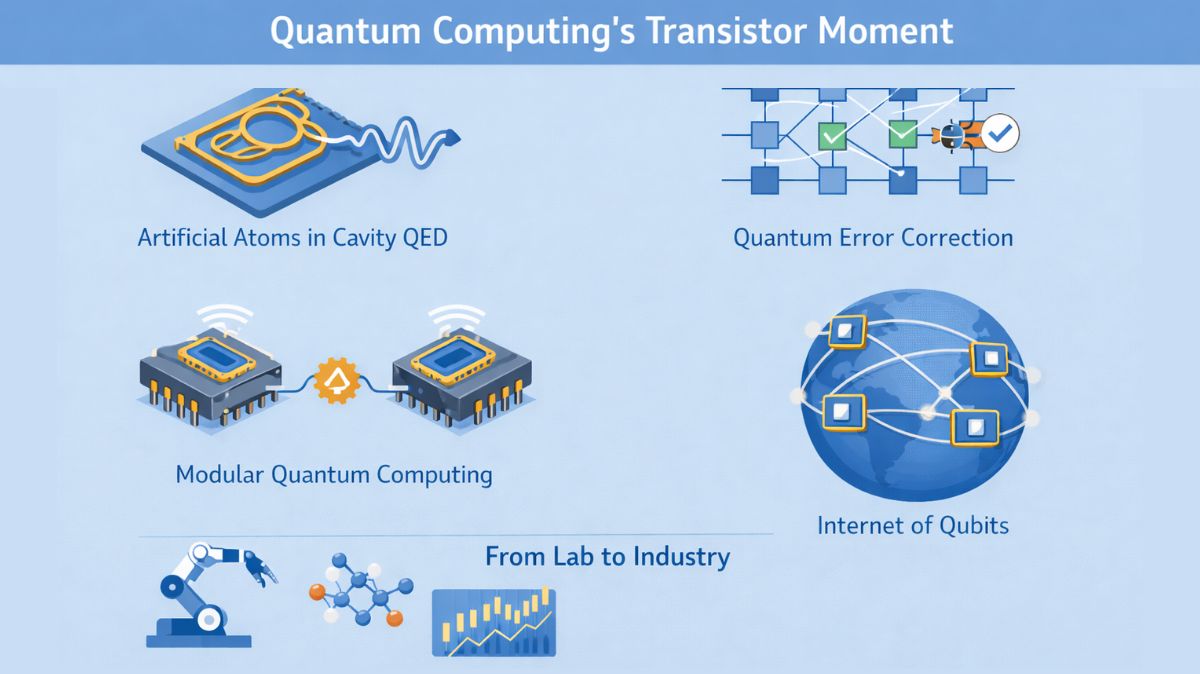
In the ambitious project to build a future quantum internet, the creation of such a loss-tolerant protocol for parallel Bell-state production is a crucial first step. Researchers are aggressively tackling the many difficulties associated with long-distance quantum information transmission with developments such as resilient quantum memory, sophisticated quantum error correction, and quantum repeaters. Known for their ability to withstand photon loss, the cat codes used in this novel protocol represent a particularly promising type of quantum error correction.
Furthermore, in order to facilitate mistake detection and repair without requiring long-lived quantum memories a significant development for photonic quantum networks new techniques like flying cat parity checks are being researched. The development of resilient quantum hardware, such as superconducting qubits, trapped ions, and cavity quantum electrodynamics, as well as fault-tolerant quantum computation, is being furthered by this research, surface codes, and dynamically protected qubits.
A Flourishing Quantum Landscape and Investment Boom
According to Quantum News, this Loss-Tolerant Qudit Protocol introduction coincides with a very exciting moment for the quantum industry. The swift advancement and large investment in quantum technologies were highlighted by the reports of several other noteworthy achievements that day.
With the bold objective of creating million-qubit fault-tolerant quantum computers, PsiQuantum was able to raise an incredible $1 billion. Simultaneously, QuEra Boston obtained $230 million with support from NVIDIA, enhancing the capabilities of quantum computing. As evidence of the practicality of quantum-safe solutions, Ueno Bank became the first bank in Paraguay to implement quantum-resistant signatures globally.
A field on the verge of a revolution is vividly depicted by these phenomena taken together. Quantum computing promises to do complicated tasks tenfold quicker than conventional computers by utilizing the concepts of quantum mechanics. Numerous fields, including finance, encryption, artificial intelligence, and material science, could be revolutionized by this. Experts and academics are actively working to uncover quantum’s enormous potential to address previously unsolvable issues, demonstrating that the “Quantum Zeitgeist” is clearly in motion.
Although the new loss-tolerant qudit protocol is a big step forward, the researchers admit that several parts of the system are simplified in their current analysis. In order to further refine the procedure for real-world use, future research will concentrate on investigating methods to reduce the remaining causes of errors. Still, this innovation offers a tangible approach to developing more resilient and scalable quantum systems with immediate implementation possibilities, as well as a vital starting point for further investigation of realistic error sources.
The path to a fully functional quantum internet and universally potent quantum computers is intricate and multidimensional. But with to developments like this parallel Bell-state generation protocol and the constant investment, the quantum era is quickly moving from theoretical promise to real-world application.


Thank you for your Interest in Quantum Computer. Please Reply