With Guppy, Selene, and Helios, Quantinuum Unveils a Revolutionary Quantum Computing Ecosystem, Leading the Way in Fault Tolerance and Improved Cybersecurity
The largest integrated quantum company in the world, Quantinuum, today announced a major advancement in quantum computing with the release of its next-generation software stack, which includes the much-anticipated Helios quantum computer, the Selene emulator, and the new quantum programming language Guppy. By strengthening cybersecurity underpinnings in the quantum age and speeding the path towards universal, completely fault-tolerant quantum computing, these technologies have the potential to establish a new industry standard.
You can also read PyQBench: Quantum Noise-based Qubit Fidelity Benchmark
Guppy
Configuring Quantum’s Future Guppy, a quantum-first programming language created from the ground up to satisfy the complex requirements of cutting-edge quantum computers like Helios, is at the centre of this new ecosystem. Guppy, which is embedded in Python, has a recognisable “Pythonic” syntax that makes it immediately usable by developers. It also offers strong abstractions and compile-time safety that outperform more conventional circuit builders like Pytket or Qiskit.
Key Features of Guppy include:
- Pythonic & Embedded: Guppy provides a clear and expressive substitute for imperative building patterns by integrating easily with pre-existing Python codebases and modules. Its source language methodology encourages algorithmic advancements by supporting higher levels of abstraction.
- Safety by Design: Guppy is statically compiled and highly typed in recognition of the cost and limited availability of quantum hardware access. By avoiding qubit memory leaks, guaranteeing no-cloning, and delivering concise, actionable error messages, this approach aids in the early detection of flaws.
- Beyond Circuits: The Quantum Kernel: The Kernel of Quantum Guppy programs are quantum kernels, not just circuit descriptions. In order to develop adaptive quantum algorithms, this novel architecture allows rich control flow based on measurement outcomes, function calls, and complicated data types. With native support for real-time feedback and standard programming constructs like ‘if’ statements and ‘for’ loops, the language lets developers create intricate, understandable programs that change as the quantum system does.
Guppy‘s architecture marks a significant shift from conventional circuit-building tools and is specifically tailored for the upcoming era of quantum computing. With fault-tolerance in mind, it optimizes qubit resource management automatically to boost productivity and lower developer overhead. This flexibility, which enables developers to use any QEC code on Quantinuum‘s QCCD architecture, is especially important for Quantum Error Correction (QEC). With the use of a new real-time control system, it can dynamically perform sophisticated protocols like magic state distillation and injection, quantum teleportation, and other measurement-based operations. Nexus, the all-in-one quantum computing platform from Quantinuum, allows for the easy submission and administration of all Guppy programs.
You can also read What is QML? How Can QML Serve as a Tool to Strengthen QKD
Selene
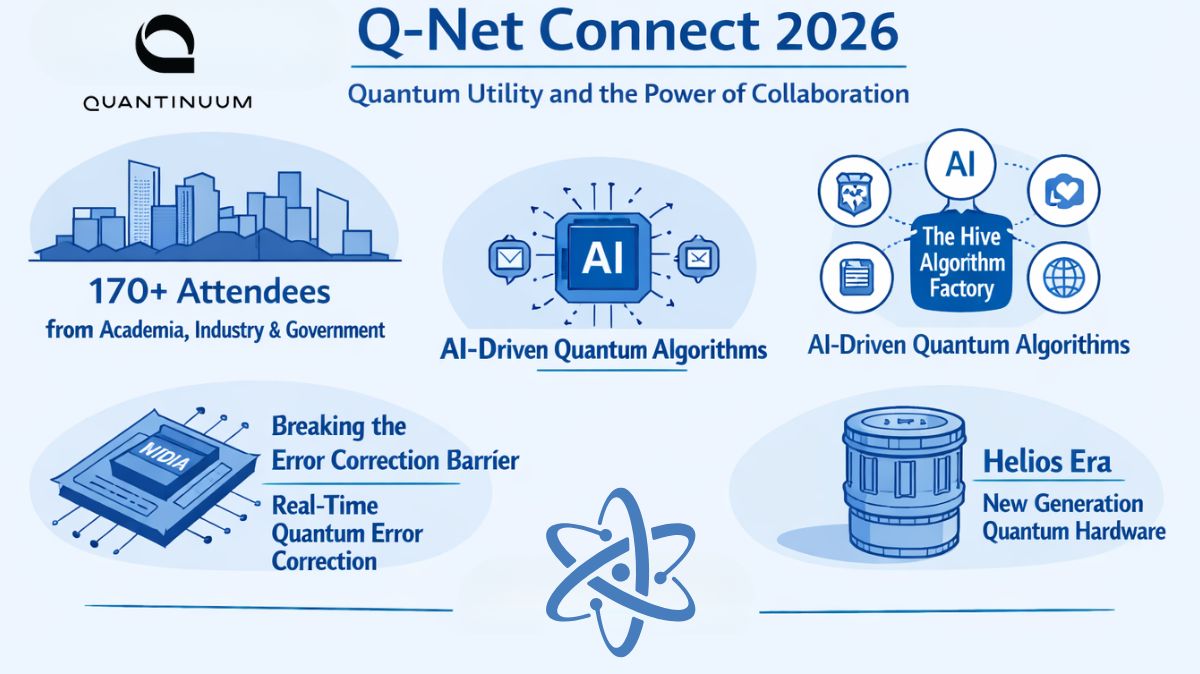
Helios’s “Digital Sister” Quantinuum has launched Selene, an open-source emulator made to precisely run compiled Guppy programs, as a companion to Guppy. Selene is Helios’ “digital sister”; it captures sophisticated runtime behavior that is specific to the hardware, such as hybrid quantum-classical logic and measurement-dependent control flow. Without having to wait for machine time on real quantum hardware, developers can now test low-level error correction and prototype new algorithms in a flexible and realistic setting.
State vector simulation (via Quest), stabilizer simulation (through Stim), and conventional replay are among the simulation backends that Selene offers; further plugins are anticipated in the near future. For effective GPU-powered simulation, especially for state-vector simulations submitted through Nexus, it also makes use of NVIDIA cuQuantum.
Helios and the Next-Generation Software Stack
The Next-Generation Software Stack and Helios Helios is a full-stack platform that is expected to improve industry standards, and its release this year represents more than just a new processor. A lower barrier to entry, a quicker time to solution, and an enhanced user experience are just a few advantages of the new software stack with Guppy and Selene. Previously employed to power customer solutions, Quantinuum’s open-source toolkit, TKET, will now only be utilized as a compiler tool chain and for Guppy program optimization.
The default method for gaining access to Quantinuum and third-party devices is still Nexus, which has been updated to support Guppy and give Selene access. Additionally, Nexus supports the industry standard Quantum Intermediate Representation (QIR), which guarantees accessibility for developers working with languages such as Microsoft Q#, NVIDIA CUDA-Q, and ORNL XACC.
You can also read A 2D Quantum Simulator Captures Real-Time ‘String Breaking’
Scaling Quantum Hardware with Integrated Photonics
Using Integrated Photonics to Scale Quantum Hardware The key problem of scaling quantum computers to millions of qubits while preserving low error rates is addressed by Quantinuum’s developments in the core hardware. Despite concerns regarding the scalability of trapped-ion technology because of its early bulky components, Quantinuum’s chip-based quantum-charge-coupled device (QCCD) architecture makes use of contemporary microfabrication capabilities. Significant advancements have already been made, with ion traps manufactured on silicon wafers and tiny diode lasers taking the place of large laser sources.
Infineon, a pioneer in the production of traditional computer chips with in-house knowledge of ion-trap quantum computing, has teamed up with Quantinuum for the next phase. In order to properly control and manipulate laser light on chips, they are working together to develop a device with integrated photonics. This breakthrough proves that QCCD quantum computing is essentially a semiconductor technology by significantly lowering system complexity and opening the door for significant scalability. Innovation has been greatly accelerated by Infineon’s proficiency in waveguide fabrication, grating coupler construction, and ultra-low optical loss deposition process optimization, as well as their sophisticated failure analysis tools.
Protecting the Future:
Proven Randomness and Post-Quantum Cryptography In addition to its exceptional computational capabilities, Quantinuum is leading the way in preserving digital trust in the quantum era. The business formed the QSafe 360 Alliance with IBM Consulting, Thales, and Keyfactor. This partnership will issue a whitepaper titled “Digital Trust & Cybersecurity After Quantum Computing” with the goal of assisting organisations in creating crypto-agile security architectures prepared for the quantum era.
The collaboration draws attention to a crucial yet sometimes disregarded weakness: the degree of randomness incorporated into encryption methods. Previous assaults, such as the Randstorm leak (millions of wallets revealed) and the Polynonce attack ($25 million stolen across Bitcoin wallets), showed how biased or poor randomization can subtly compromise cryptographic security for years, even when algorithms work as intended. Even though post-quantum cryptography (PQC) methods are meant to withstand quantum attacks, they still rely on random variables.
This is addressed by Quantinuum’s Quantum Origin, which uses a radically new method to provide proved randomness. It makes use of mathematical procedures known as strong seeded randomness extractors, which convert even weak local entropy into output that can be proven to be secure. These extractors are fuelled exclusively by a Quantum Seed, which is created once by Quantinuum’s quantum computers utilizing Bell-tested quantum procedures. Because of this one-time quantum generation, Quantum Origin can be used as a software-only solution with the greatest amount of flexibility.
It is validated to NIST SP 800-90B standards and integrates easily with current infrastructure, including cloud, on-premises, air-gapped networks, and embedded platforms, without the need for additional hardware or network connections. This method creates a safe basis for putting NIST PQC algorithms into practice while also fortifying the current implementations of AES, RSA, ECC, and other algorithms.
Quantinuum leads the quantum computing revolution with its comprehensive approach that includes cutting-edge hardware, software, and cybersecurity. These fundamental advances are needed to build scalable, programmable, real-time quantum computing to solve society’s biggest problems.
You can also read Karnataka Funds ₹48 Crore for Quantum Research Park phase 2


Thank you for your Interest in Quantum Computer. Please Reply