For nearly a decade, “utility-scale” quantum computing was always “just a few years away.” The primary obstacle was a stubborn physical reality known as decoherence, in which the delicate quantum bits (qubits) at the heart of these machines would lose their data in a millisecond due to “noise” environmental interference as small as a stray magnetic field or the heat from a human breath. However, the decades-old field of Quantum Electrodynamics (QED) has become the industry’s savior as the first quarter of 2026 comes to an end.
Researchers at international centers like IBM, Google, and the Zurich Quantum Hub are finally creating fault-tolerant devices that can self-correct mistakes by understanding the basic principles of light and matter interaction. This change represents what experts refer to as the “transistor moment” for quantum technology the moment when the hardware is dependable enough to be widely used in industry.
The Engineering of “Artificial Atoms”
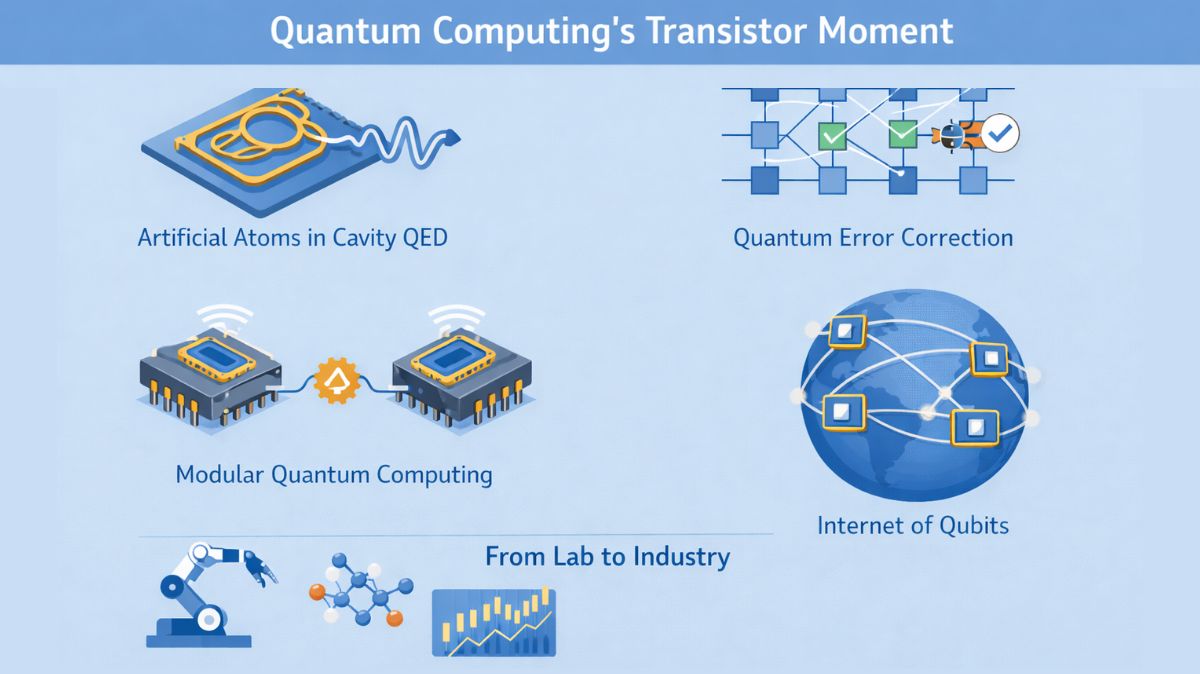
Circuit QED, a solid-state version of conventional cavity QED, is at the heart of this innovation. Data travels by electrons via copper lines in classical computing. In the quantum world of 2026, engineers are trapping “artificial atoms” which are actually superconducting loops inside microwave cavities.
According to Dr. Elena Vance, a principal researcher at the Zurich Quantum Hub, “in a traditional experiment, you’d try to trap a single atom between mirrors and hit it with a laser, but in Circuit QED, the ‘cavity’ is a wire on a chip.” As a result, we are able to achieve a strong coupling regime in which the photon and the qubit behave as one cohesive entity. High-fidelity gates and measurements, the fundamental components of a working computer, are made possible by this exact control over light-matter interaction.
You can also read Nuclear Magnetic Resonance NMR In Quantum Computing
Defeating the Noise Crisis
The rigorous mathematical framework that QED offers is now used to control the “noise” that once caused quantum algorithms to crash. These days, engineers may create complex “filters” that let control signals into the system while preventing harmful outside interference.
Even more drastic alternatives have been introduced in recent advances. Chalmers University of Technology researchers announced the “Giant Superatom” just last week. They have effectively suppressed decoherence to previously unheard-of levels by using QED principles to make several artificial atoms act as a single unit. Additionally, “erasure conversion,” a method that pinpoints the precise location of a photon loss within a system and corrects the defect before the computation fails, is currently being used by the industry. This has made it possible to develop more sophisticated Quantum Error Correction (QEC) protocols, demonstrating that the “surface code” the idea that adding more qubits can really lower the overall error rate can be achieved.
The Rise of the “Internet of Qubits”
The departure from monolithic chips is arguably the biggest change in 2026. The number of qubits that could be physically packed onto a single chilled processor was the limit of quantum computers until recently. QED is used by the new architecture, called Modular Quantum Computing, to bridge the gap between “flying” light and immobile matter.
Stationary quantum information in a superconducting qubit is transformed into a “flying qubit” (a photon) using Quantum Interconnects based on Cavity QED. This photon can then connect several 1,000-qubit devices into a large, cohesive system by passing through an optical fiber to another CPU. This is what Dr. Vance refers to as the “Internet of Qubits,” a network that enables scalability that was previously unthinkable. By entangling states over far-off places, this technology is also serving as the foundation for the Quantum Internet, allowing for extremely secure communication.
You can also read QuiX Quantum Joins Q Alliance to Build Italy’s Quantum Hub
From the Laboratory to the Global Market
These QED-based frameworks’ stabilization is already producing practical outcomes. The implementation of a quantum-inspired optimization system for autonomous robots, which makes use of microwave control logic refined in QED labs, was disclosed this morning by Toshiba and MIRISE.
Giants in the financial industry are now simulating previously “uncomputable” market movements by doing “GigaQuOps” billions of error-free operations. Furthermore, hybrid quantum-classical systems are developing, combining these new computers with potent GPUs to hasten advances in logistics and materials research. Even “qudits” multi-state photon systems that encode data in more than two states and boost processing power without increasing hardware complexity are becoming more and more popular.
A New Season for Science
It seems that the “Quantum Winter” that doubters foresaw just a few years ago has been avoided. A “Quantum Spring,” driven by the same ideas of matter and light that Richard Feynman initially put forward almost a century ago, has taken its place. The impetus is unquestionable, even though there are still difficulties in creating high-quality cavities and striking a balance between speed and scalability.
“QED was the first great triumph of 20th-century physics,” Vance said. “It’s fitting as it is the core of the 21st century’s greatest technological leap” . As 2026 goes on, the question is no more whether these devices will function, but rather how soon the worldwide QED infrastructure can be expanded to realize the quantum era’s full potential.
You can also read Memory Control in Optical Quantum Reservoir Computing


Thank you for your Interest in Quantum Computer. Please Reply