Quantum Fluid Dynamics: QubitSolve Secures $1.2 Million NSF Grant to Revolutionize Engineering Simulations
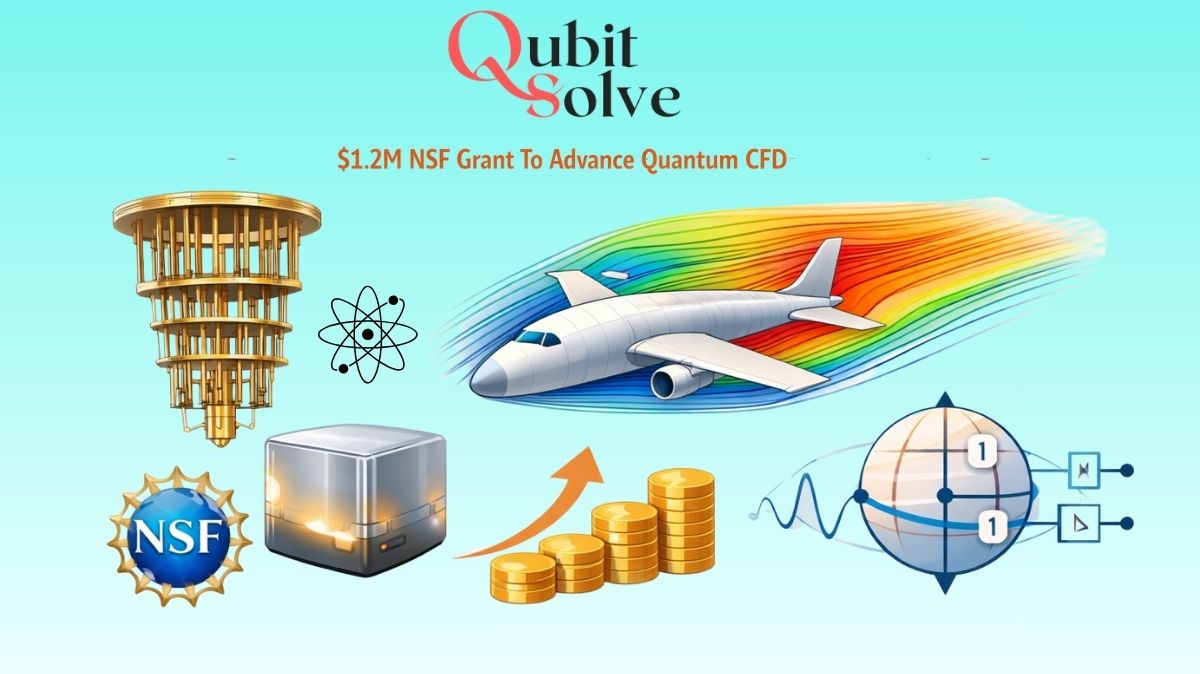
In a major step forward for high-performance engineering, the U.S. National Science Foundation (NSF) has given a $1,197,002 Small Business Innovation Research (SBIR) Phase II grant to Morgantown, West Virginia-based firm QubitSolve Inc. With a commercial release planned for late 2027, this significant funding is intended to expedite the company’s patented quantum computational fluid dynamics (CFD) software’s transition from its present 2D prototype to a 3D minimum viable product (MVP).
You can also read SandboxAQ LQMs In Cancer Detection & Treatment for SU2C
The Complexity Crisis: Why Classical Computing is Stalling
To forecast how fluids like air, water, or fuel will interact with physical structures, modern engineers mostly rely on CFD. It is the basic science used to simulate heat dissipation in high-performance engines, water resistance against a submarine hull, and air flowing over an aeroplane wing. But high-fidelity CFD is infamously “computationally expensive,” frequently straining the physical capabilities of traditional supercomputers.
Engineers are discovering that even the most potent supercomputers in the world have trouble handling intricate, non-linear simulations incorporating turbulence as classical technology gets closer to the limits of Moore’s Law and the historical trend of doubling computing capacity every two years. Because digital models are not accurate enough, industrial enterprises must wait months for results and spend millions of pounds on actual wind tunnel testing due to this computational bottleneck. (Note: Although the broad physics backdrop of these constraints is well known in the area, the specific reference to Moore’s Law and the “holy grail” status of Navier-Stokes.
VQCFD: A Paradigm Shift in Algorithmic Design
QubitSolve‘s unique Variational Quantum CFD (VQCFD) method is the “complexity crisis” answer. The Navier-Stokes equations, which control fluid flow behaviour and are regarded as some of the most difficult mathematical underpinnings in physics, are particularly covered by this framework.
In contrast to traditional techniques, which discretize space into millions of distinct “cells” a procedure that performs badly as simulation complexity rises Fluid flow fields are directly encoded as the amplitudes of quantum states spaces using VQCFD. The software aims polylogarithmic complexity scaling in the number of qubits by representing fluid fields using Parameterized Quantum Circuits (PQC).
Practically speaking, this means that the amount of quantum computing power needed for a simulation does not have to grow at the same linear or exponential pace as it would for a classical machine when the simulation gets far more complicated. This effectiveness presents a possible route to “quantum advantage,” wherein industrial-scale simulations that would paralyse a classical supercomputer can be handled by quantum processors.
You can also read SandboxAQ AQNav & Acubed For Quantum Magnetic Navigation
Optimizing for the NISQ Era
Highly specialized hardware integration is needed to make the transition from theoretical mathematics to a working commercial product. In order to accomplish this, QubitSolve has collaborated with Infleqtion, utilising the Superstaq platform and their knowledge of quantum software.
Optimizing QubitSolve’s CFD algorithms for existing Noisy Intermediate-Scale Quantum (NISQ) technology is the main goal of this collaboration. The company’s goal is to “squeeze” the most performance out of existing equipment by utilising Superstar’s software optimization layer, pushing the boundaries of what is currently feasible in aerospace and military design.
Aircraft noise reduction is one of the main goals of this partnership, as it is crucial for the effectiveness of commercial aviation as well as military stealth capabilities.
You can also read DoW CIO & SandboxAQ Launch 5Y post-quantum cyber defense
Economic Impact and the “Silicon Prairie”
The $1.2 million grant award is a strategic investment in American deep-tech leadership, not just a financial boost. QubitSolve, a Morgantown-based company that exemplifies the expanding “Silicon Prairie” movement, shows that state-of-the-art quantum software may be created outside of conventional technological centers like Palo Alto or Boston.
The QubitSolve’s founder and CEO, Dr. Madhava Syamlal, the program is meant to “unlock simulations previously out of reach,” particularly assisting in the development of cutting-edge naval systems and fuel-efficient aircraft. Making high-fidelity simulations accessible to mid-sized engineering organizations as well as aerospace giants is the long-term goal. The QubitSolve, the technology could save the engineering sector billions in R&D expenses over the next ten years by eliminating the need for physical prototypes and speeding up development cycles.
The Road to 2027
This “Quantum Engineering” period has an ambitious timeline. QubitSolve is now concentrating on the shift from 2D proofs-of-concept to the 3D engine with Phase II financing from the NSF’s America’s Seed Fund, a program devoted to promoting inventions with significant economic and societal significance.
A significant shift in the way the behaviour of the most complicated fluids in the world is decoded at the atomic level will occur if QubitSolve is able to demonstrate that its VQCFD framework can perform better than classical solvers on practical industrial jobs.
You can also read Defense Innovation Unit News: DIU Adds SandboxAQ’s AQNav

Thank you for your Interest in Quantum Computer. Please Reply