Australia and Finland Form a Strategic Partnership to Commercialize Quantum Technology in Quantum Leap
CSIRO News Release
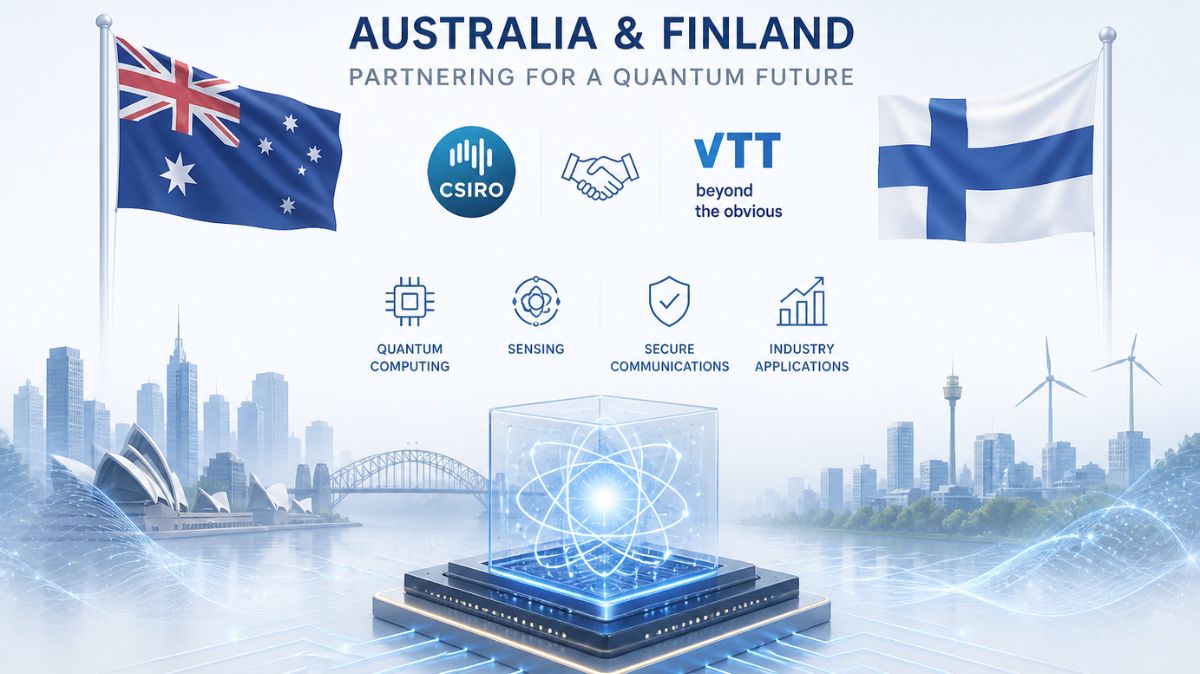
A high-level delegation from Finland’s VTT Technical Research Centre has gathered with Australia’s national research agency, CSIRO, to begin a historic joint venture that is expected to completely change the worldwide landscape of future technology. The collaboration is a component of VTT’s ambitious new project called the “Quantum Leap” project, which was announced in April, 2026, at the Quantum Australia Conference. The goal of this worldwide organization is to advance quantum technology from theoretical investigation to real-world application.
You can also read SemiQon, VTT Quantum win EARTO Award for Cryogenic CMOS Chip
From Laboratory to Industry
The main goal of the Quantum Leap project is to overcome the technological obstacles that now stand in the way of quantum computers being widely used in industry. According to reports, the alliance will create quantum software, advanced error correction and mitigation approaches, and hardware components to increase quantum system energy efficiency, reliability, and scalability.
The importance of these worldwide networks was stressed by VTT Research Manager Dr. Anu Kärkkäinen, who claimed quantum technologies will deliver “unprecedented advances in computing, sensing, and communications.” She stressed the need of working with CSIRO to accelerate the development of solutions that might transform business and society worldwide.
The partnership provides a means of expediting research and development from an Australian standpoint. According to Dr. Anthony Chesman of CSIRO, collaborating with Finnish partners, who have similar infrastructure and knowledge, enables both countries to learn more quickly and minimize effort duplication. He stated that connecting the two nations’ thriving quantum ecosystems and providing “practical quantum advantage outside the lab” are the objectives.
You can also read Janne Lehtinen Positions SemiQon Ahead in Quantum Race
A Robust Ecosystem of Innovation
Government organizations are not the only ones involved in this collaboration. In the Quantum Leap initiative, VTT has incorporated a wide variety of Finnish academic and business stakeholders. These comprise:
- Academic institutions: Jyěskylä University and Tampere University.
- Leaders in the industry include specialized businesses like Neste, Vexlum, and Quanscient as well as quantum computing companies like IQM and SemiQon.
The project will entail a number of organized activities, such as research exchanges, collaborative workshops, and the production of white papers, to guarantee the success of this cross-continental endeavor. By identifying new industrial use cases and promoting knowledge transfer, these initiatives aim to guarantee that the technology satisfies the unique requirements of contemporary manufacturing and commerce.
You can also read EU funds €50M in Superconducting European Quantum Pilot line
The Worldwide Setting: A Competition for Domination
Australia and Finland’s alliance intensifies the global “Quantum Race”. US, China, and EU economies are investing billions in quantum research. Mid-sized “quantum powerhouses” like Finland and Australia can more successfully compete with larger countries by combining their resources.
Australia has long been known for its top-notch research in photonics and silicon-based quantum computing, while Finland has a long history of hardware engineering and cryogenics. The first really commercially feasible “noisy intermediate-scale quantum” (NISQ) devices might result from the powerful combination of Finnish hardware expertise with Australian software capability.
You can also read SPINS Pilot Line advances semiconductor quantum technologies
The Pragmatic Frontier
The quantum bits (qubits) of today are extremely susceptible to “noise,” or influence from the surroundings. Large-scale computations are still unattainable unless researchers can successfully reduce these inaccuracies. The CSIRO-VTT collaboration is concentrating on energy efficiency and dependability to address the “boring but essential” technical problems that will eventually dictate which quantum systems may be included in current data centers.
The “Quantum Leap” initiative signifies a change in emphasis from “if” quantum computing will work to “when” and “how” it can be scaled for widespread use, as sectors including pharmaceuticals, logistics, and climate modeling seek to quantum solutions to address complicated optimization issues.
You can also read Infineon Technologies News: Powers Europe’s Quantum Future
Conclusion: A Shared Vision
Finland’s Minister for Foreign Trade and Development, Ville Tavio, attended the Adelaide conference, highlighting the diplomatic and commercial importance of this scientific collaboration. By combining VTT’s technological competence with CSIRO’s mission-driven research, the two countries are leading the industrial revolution.
According to the Quantum Leap project’s plan, quantum advantage will be a real force behind sustained innovation and economic progress in the future, rather than merely a scientific achievement. As Dr. Chesman pointed out, the most realistic approach to make sure that the “leap” made today is firmly established tomorrow is to be able to connect individuals across various ecosystems.
You can also read The Transverse Field Ising Model TFIM For Quantum Algorithms


Thank you for your Interest in Quantum Computer. Please Reply