In this article, we will know about, Andhra Pradesh launches India’s first indigenous quantum testbeds in Amaravati, marking a major leap into global deep-tech innovation.
Andhra Pradesh opened India’s first indigenous quantum computing test and reference facilities, marking its entry into the global deep-tech infrastructure race. The inauguration on April 14, 2026, World Quantum Day, marks a turning point for Amaravati, the “Quantum Valley” of India.
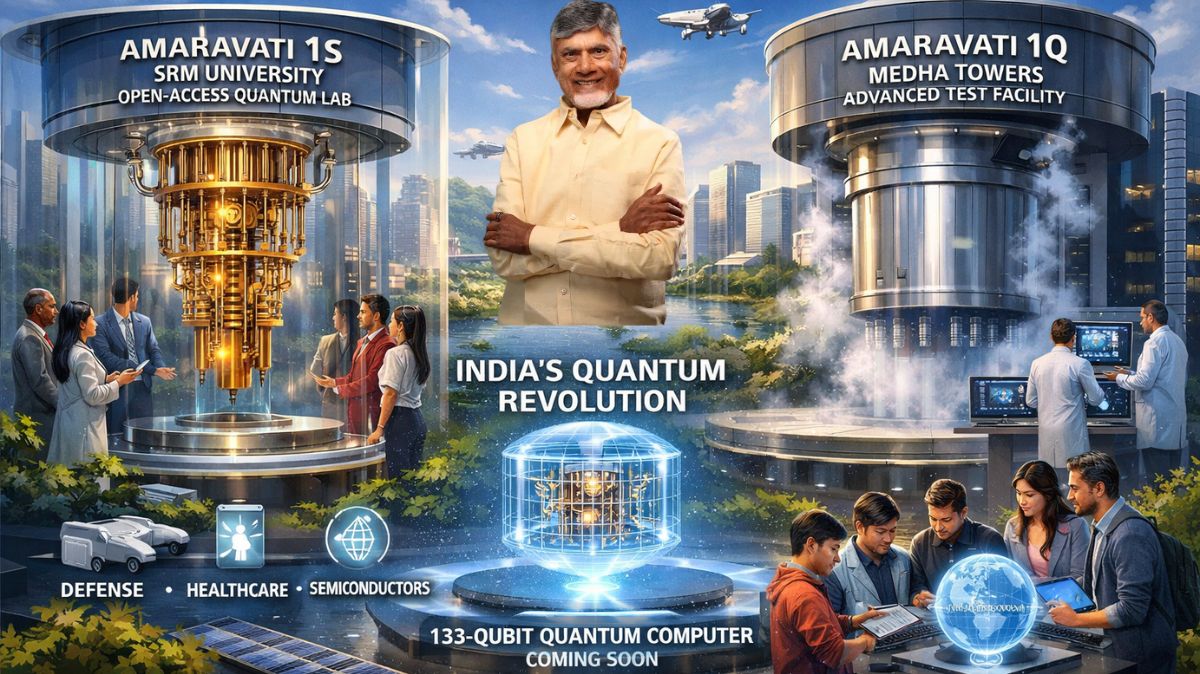
Chief Minister N. Chandrababu Naidu launched the Amaravati 1S at SRM University and the 1Q at Medha Towers in Gannavaram. These facilities, which are intended to advance India beyond theoretical policy discussions into the domain of practical quantum validation and experimentation, are the nation’s first physical infrastructure of their sort.
You can also read Amaravati CRDA Launches Quantum Valley with ₹103.96 Crore
A Dual-System Strategy for Innovation
The effort uses a deliberate two-pronged strategy to promote academic collaboration and rigorous industrial testing. The Amaravati 1Q system at Medha Towers is designed especially for advanced component testing, with an emphasis on validating crucial hardware under harsh circumstances, including amplifiers, control systems, and cryogenic electronics. Officials displayed a live commencement sequence for the 1Q system at the launch, which included the processor’s key cooling, a high-precision procedure necessary for quantum stability.
SRM University’s Amaravati 1S system, on the other hand, is intended to be an open-access platform. The 1S system, which was developed utilizing superconducting technology, aims to democratize access to quantum hardware by enabling researchers, startups, and students to test and validate their own quantum technologies. Since quantum infrastructure is usually limited to highly specialized, private laboratories, this degree of transparency is uncommon globally.
You can also read Quantum Valley Amaravati To Host India’s Quantum BioFoundry
The Technical Marvel of Indigenous Engineering
The Amaravati launch’s indigenous technology is crucial. Top Indian institutes including the Tata Institute of Fundamental Research (TIFR), Indian Institute of Science (IISc), and Defence Research and Development Organisation (DRDO) developed every component of these testbeds domestically.
To run these devices, temperatures must be near to absolute zero -273 degrees Celsius. Such intense cooling is a non-negotiable need for quantum coherence, according to Professor Ch Satish Kumar, Vice-Chancellor of SRM University, guaranteeing that the systems operate precisely without interference from thermal noise. India is drastically lowering its strategic reliance on foreign infrastructure for deep-tech development by mastering these cryogenic and precision electronic settings at home.
You can also read Dormant Bitcoin Wallets: Hidden Treasure of the Crypto World
Building the “Quantum Valley” Ecosystem
Launches are crucial to India’s National Quantum Mission’s Amaravati Quantum Valley project. This effort unites the nation’s quantum activities into a talent, infrastructure, and research ecosystem. In addition to announcing ambitions to someday host a 133-qubit quantum system, the state administration has already established over 80 relationships with academic institutions and business.
The technologies created for these testbeds, including advanced cryogenics, are anticipated to have an impact on other high-value industries in addition to computing’s immediate objectives. Defense, healthcare, and semiconductor manufacturing are possible uses, which might hasten Andhra Pradesh’s development as a top technological destination.
You can also read SandboxAQ News in Virtual Scholarship Conference 2026
Democratizing the Future: 1.5 Lakh Students Witness History
The inauguration’s enormous level of participation was one of its most notable aspects. Over 1.5 lakh students from Andhra Pradesh’s colleges and institutions participated virtually with the government’s efforts to motivate the next generation of scientists. To ensure that young Indian innovators are ready for the changing global economic scene, IT Minister Nara Lokesh underlined that the project is intended to provide worldwide employment prospects.
PS Pradyumna, the chief minister’s secretary, noted that the current systems are modest but powerful and provide a vital home platform for entrepreneurs to test components without the significant costs of finding facilities outside. The strong enrollment rates in state-sponsored programs for cutting-edge technology like AI and quantum physics show that this accessibility focus is paying off.
You can also read IonQ Company News: Extending Quantum Networking with UMD
The Global Context and Future Outlook
Amaravati’s action shows that India is prepared to compete on the international scene while the US and China continue to rule the quantum space. A domestic testing and certification environment makes it easier for Indian deep-tech companies to reach the market, which might lead to a revolution in quantum innovation at the local level.
According to Chief Minister Naidu, quantum technology would eventually be crucial in a number of areas, including climate simulations and governance. Although there are still many technical and business obstacles in the industry, the introduction of the 1S and 1Q testbeds is an important first step. India’s quantum aspirations are no longer limited to vision documents; they are now materializing in Amaravati’s cooling chambers, prepared for future testing, research, and scaling.
You can also read BMO Latest News with QIC & CQE to Boost Quantum in Banking



Thank you for your Interest in Quantum Computer. Please Reply