Integrated Photonics News
Quantum technology is no longer limited to academic labs’ massive vibration-isolation optical workbench. Communication security, ultra-precise sensing, and high-performance computation are poised to benefit from chip-scale quantum photonics. By miniaturizing sophisticated quantum experiments into photonic integrated circuits (PICs), researchers are using mass-manufacturing methods like CMOS to develop scalable and robust quantum hardware.
You can also read Kicked Ising Model Quantum Battery Breakthrough Explained
The Shift to Continuous Variables
A parallel paradigm known as continuous-variable (CV) quantum optics is gaining substantial traction, while many quantum systems rely on discrete-variable (DV) techniques, which define states by individual photon counts. The CV method uses the continuous electric field quadratures in a phase-space representation to define quantum states, in contrast to the DV regime’s use of the Fock basis.
The ability to deterministically create and entangle quantum states at ambient temperature is the main driving force behind this change. By doing this, the probabilistic character of single-photon is avoided. Additionally, CV states are extremely compatible with current telecommunications infrastructure since they may be identified and characterized using high-efficiency, room-temperature photodiodes and high-bandwidth homodyne detection.
You can also read Vacuum State In Quantum Field Theory: A Complete Guide
Squeezing Light for Precision
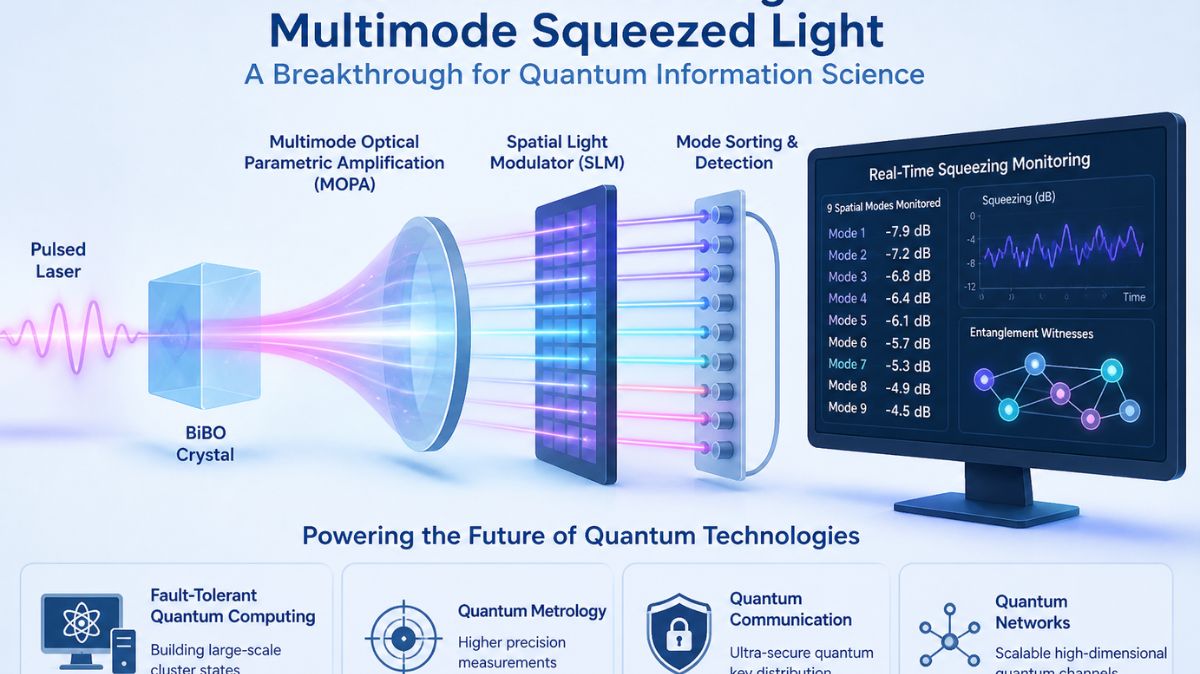
The compressed state of light is fundamental to CV technology. The electric field fluctuations in these states are smaller than the typical quantum limit of shot noise. Researchers can make measurements with previously unheard-of precision by “squeezing” the noise in one quadrature of the light; this method is already used to detect gravitational waves.
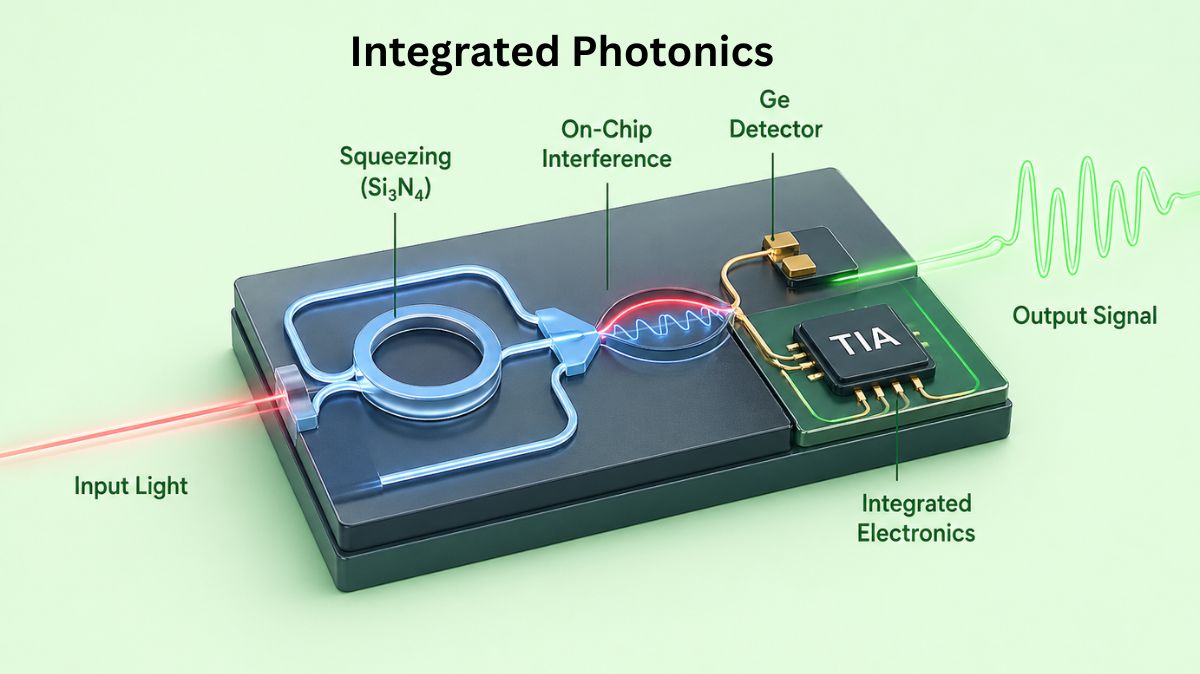
These states are usually produced on a chip by nonlinear optical processes like the optical Kerr effect or four-wave mixing (FWM). Due to their low optical losses and lack of two-photon absorption, which is a problem for conventional silicon at telecommunications wavelengths, materials such as silicon nitride (Si3N4) have emerged as the preferred platform. Recent advances have allowed Si3N4 microring resonators, which function as optical parametric oscillators (OPOs), to directly measure intensity-difference squeezing up to 3.7 dB, with over 10 dB implied to exist on the semiconductor itself.
You can also read Advanced Quantum Testbeds(AQTs) For Quantum Research
Breaking the Detection Barrier
The detecting gear needs to be as sophisticated for CV quantum technologies to be effective. Optical homodyne detection, in which a strong classical “local oscillator” (LO) interferes with a faint quantum signal, is the gold standard for measuring these states. This makes it possible for researchers to retrieve the quantum state’s phase-sensitive information.
However, the interface between the photonic chip and the readout circuitry has been a significant obstacle to scaling these detectors. Parasitic capacitance limits the detection bandwidth in conventional configurations that wire-bond a photonic chip to an independent printed circuit board (PCB). Researchers are working toward monolithic electronic-photonic integrated circuits (ePICs) as a solution. The 3dB bandwidth has been increased from a simple 150 MHz to a record 15.3 GHz by combining the photonics and transimpedance amplifier (TIA) circuitry onto the same semiconductor die, allowing for significantly quicker quantum information processing.
You can also read QUBO Formulation Unlocks 40% Circuit Depth Reduction
From Secure Keys to Quantum Computers
Integrated CV photonics is already being used in real-world applications. Integrated silicon PICs have successfully transferred safe keys over distances more than 28 km in the field of Quantum Key Distribution (QKD), with secret key speeds as high as Mbit/s. These technologies offer a practical path for secure international communication networks since they function with common telecom components.
Integrated phase sensors utilizing squeezed vacuum states on-chip were proven to be able to exceed the usual quantum limit in quantum metrology, providing a 3.7% increase in signal-to-noise ratios for radio frequency transmissions. Eventually, such small sensors might be employed for local refractive index monitoring or improved biological imaging.
CV quantum computing is arguably the most ambitious application. Gaussian boson sampling (GBS), a forerunner to more intricate quantum simulations, has already been accomplished by researchers using silicon circuits. Even “scale-models” of quantum computers, like the Aurora system, which creates entangled cluster states using 35 distinct photonic devices, have been created by companies like Xanadu. This modular solution uses Si3N4 for squeezing, lithium niobate for rapid switching, and silicon for detection to maximize each platform’s benefits.
You can also read Adiabatic Evolutionary Quantum System In Quantum Learning
The Path to Monolithic Integration
Even with these quick developments, problems still exist. The “ultimate goal” is to create a genuinely monolithic device with high-quality, low-loss manipulation circuits, and high-efficiency detectors. There is now a discrepancy: Si3N4 is good at producing compressed light, but it is challenging to integrate with the high-speed germanium detectors that are common on silicon platforms.
Selecting the appropriate materials and manufacturing techniques to close this gap will determine the field’s future. The integration of CV experiments onto ePICs is anticipated to accelerate the implementation of practical quantum technologies across sensing, communication, and computation as engineering challenges such as off-chip coupling losses are resolved. The quantum revolution is slowly approaching the palm of our hand by utilizing integrated photonics’ stability and manufacturability.
You can also read IQM Quantum Stock: Europe’s €40M Improves Quantum Market

Thank you for your Interest in Quantum Computer. Please Reply