Overview
To enable complex quantum chemistry simulations, this article presents Kvantify Qrunch, a specialized software application made to work with Amazon Braket. Through hybrid algorithms such as FAST-VQE and BEAST-VQE, the platform offers researchers the ability to perform intricate molecular computations on modern noisy quantum hardware. By automating circuit construction and offering smooth access to a variety of cloud-based quantum computers, the program streamlines the computational chemist’s user experience. The system’s ability to scale to 80 qubits is demonstrated in a highlighted case study on drug development, successfully bridging the gap between theoretical quantum mechanics and real-world commercial application. Finally, it emphasizes how high-accuracy modeling of large-scale chemical interactions is made possible by projective embedding and unique gate selection algorithms.
Kvantify Qrunch on Amazon Braket
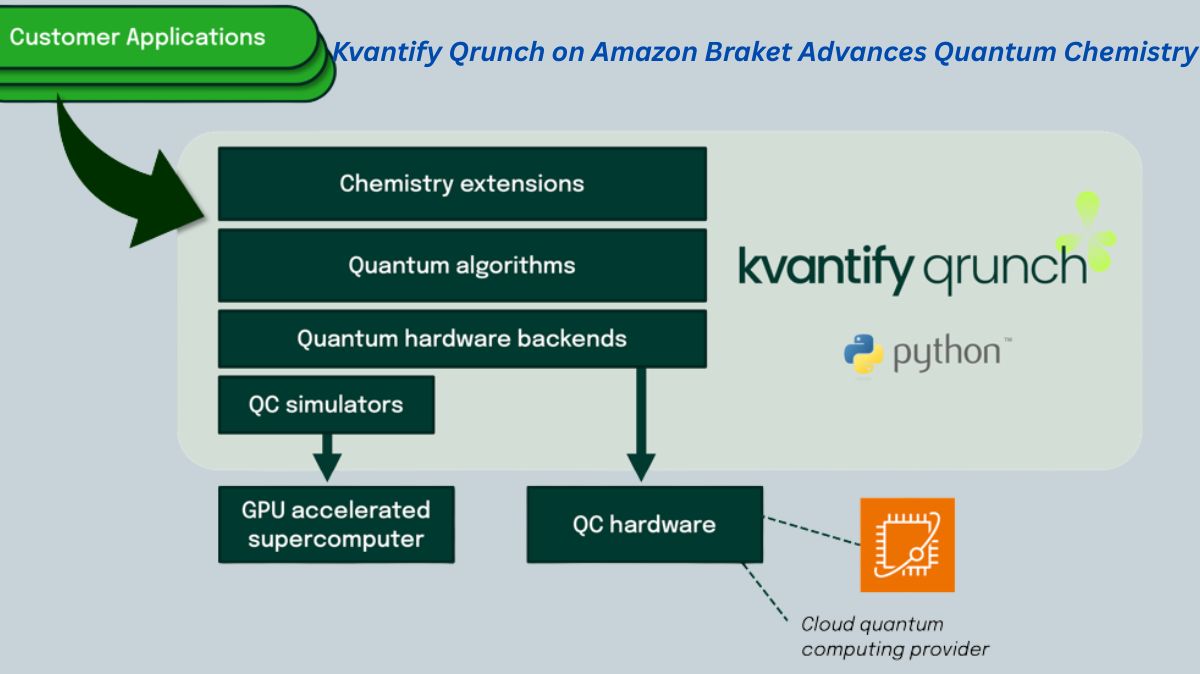
A new software integration is bringing the power of quantum computing right to computational chemists’ desks, marking a significant change for the biotech and pharmaceutical sectors. Qrunch on Amazon Braket, a software package created to carry out sophisticated quantum chemical computations on today’s Noisy Intermediate-Scale Quantum (NISQ) devices, has been released by Kvantify in partnership with Amazon Web Services (AWS).
Because molecular interactions are fundamentally quantum mechanical, chemistry continues to be one of the most promising fields for quantum advantage. However, the physical noise in existing quantum hardware and the high learning curve needed for chemists to build and route intricate quantum circuits have long been the field’s main roadblocks. By offering a “missing software link” that abstracts the intricacy of quantum physics into a recognizable Python-based environment, Kvantify Qrunch seeks to address these issues.
Simplifying the Quantum Workflow
The switch to quantum technologies has frequently seemed like learning a new language for working chemists. By enabling researchers to create applications without having to handle distant hardware backends or go deeply into circuit design, Qrunch eliminates these obstacles. Using a fluent builder style, the program walks users through the process of establishing molecular configurations, whether they are uploaded as PDB files or standard.xyz files, and makes sure all requirements are satisfied for a legitimate simulation.
The projective embedding approach is one of the platform’s most notable characteristics. This approach, which has been called a “onion-like” structure, enables researchers to use their computer resources very selectively. For the “inner regions” of a molecule, where complex electronic correlations are most important, a chemist can use advanced quantum computing techniques; for the outer layers, they can use molecular mechanics or conventional Density Functional Theory (DFT). By ensuring that quantum power is used precisely when conventional approaches fail, this hybrid methodology makes it possible to simulate far bigger systems than were previously feasible.

Exclusive Algorithms: BEAST and FAST
Under the hood, Qrunch makes use of the patented FAST-VQE and BEAST-VQE algorithms from Kvantify. These “Variational Quantum Eigensolver” techniques are especially tailored for calculating ground-state energy. BEAST-VQE (Binary-Excitation Adaptive Selection Tool) provides a more accurate but incredibly scalable solution than standard VQE techniques, which can be overpowered by noise and resource demands.
BEAST-VQE offers three revolutionary advantages by considering paired electron excitations as bosonic particles: it substantially lowers circuit complexity, simplifies Hamiltonian measurements to a constant value, and halves the number of qubits needed. Compared to “vanilla” VQE approaches, where the measurement needs increase exponentially with system size, this is a major gain. Even with today’s flawed technology, both algorithms can extract high-quality data because of their intrinsic noise-resilience.
Impact in the Real World: The Osteoporosis Showcase
Kvantify and AWS presented a case study that was pertinent to the management of postmenopausal osteoporosis to illustrate the platform’s scalability. The Cathepsin-K enzyme and its relationship to the strong covalent inhibitor odanacatib were the main subjects of the simulation.
Covalent ligands, or medications that create a permanent chemical connection with their target, are notoriously hard to model using traditional methods like force fields because they frequently can’t capture the changing electron distributions that occur during bond formation. The team was able to describe this complex binding process with great accuracy by creating a quantum active space surrounding the sulfur atom of the enzyme and the carbon group of the ligand, and then using DFT to incorporate the rest of the environment.
Using Amazon Braket, the computation was scaled to an astounding 80 qubits using the Rigetti Ankaa-3 hardware. Without substantial assumptions, this simulation, which involves 80 orbitals and 24 electrons, would not be viable using traditional techniques on classical computers. The outcomes demonstrated that Qrunch can effectively use large-scale hardware in spite of current noise levels, closely matching noiseless benchmarks.
A Path to 100 Qubits and Beyond
Kvantify’s memory-restricted simulator cleared the way for the transition to 80 qubits by addressing the bottleneck where workloads for classical computing increase significantly as state vectors rise. The system can simulate systems up to hundreds of qubits with no effect on energy accuracy by trimming the state vector to reduce memory use.
Availability and Prospects
Amazon Braket now offers three different licensing packages for Kvantify Qrunch. While the Pro and Enterprise editions provide infinite qubits, increased hardware access, and specialized scientific support, the Basic version is free and supports up to 35 qubits.
The integration is a big step toward using quantum technology for molecular simulations on a regular basis. Kvantify and AWS are opening the door for quicker drug discovery and the creation of novel materials for carbon capture and enzymatic reactions by freeing up domain specialists to concentrate on chemistry rather than quantum infrastructure.
This simplified gateway promotes “optimistic exploration” in academia and business, bringing the quantum future into the contemporary laboratory, as Ulrich Hoff, a Quantum Engagement Specialist at Kvantify, stated in the press announcement.
You can also read Munich Quantum Software Company with Xanadu PennyLane

Thank you for your Interest in Quantum Computer. Please Reply