Microchip TS1800
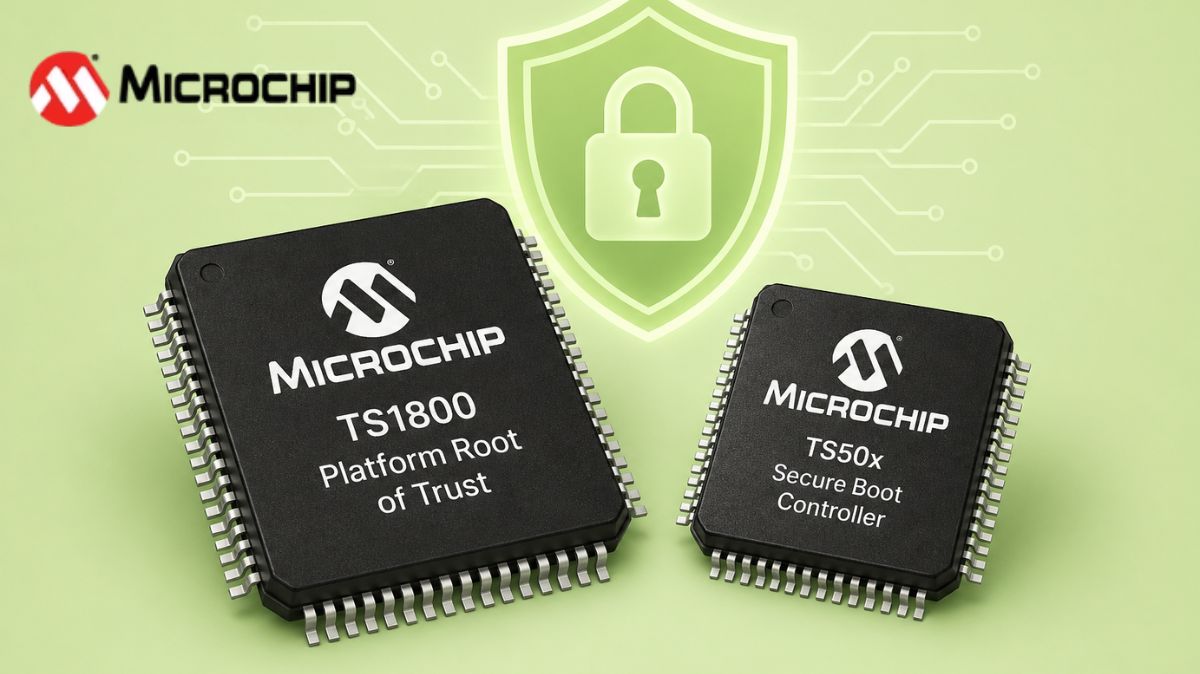
Microchip IT has announced a significant increase of its security portfolio as the world’s IT industry starts the crucial shift toward post-quantum cryptography (PQC). The TS1800 Platform Root of Trust (RoT) controller and the TS50x secure boot controller are two new products from the firm that are intended to give “quantum-safe” systems a hardware-based foundation. The purpose of these new members of the Trust Shield family is to assist system builders in navigating a quickly changing environment of cybersecurity regulations and new threats.
You can also read McKinsey Quantum Technology Monitor commercial tipping point
Addressing a Pressing Global Mandate
The transition to PQC is no longer a theoretical issue for the far future. Nuri Dagdeviren, corporate vice president of Microchip’s secure computing division, claims that the implementation problem is already at many businesses’ “doorstep” and is happening far more quickly than industry experts had previously predicted. Microchip is directly incorporating PQC readiness into the base of system trust to address this difficulty.
The purpose of these new controllers is to help architects adhere to strict new requirements, like the Commercial National Security Algorithm Suite 2.0 (CNSA 2.0) and the European Cyber Resilience Act (CRA). The TS1800 and TS50x offer the security infrastructure required for critical infrastructure platforms such as data centers, telecommunications, and defense by supporting these standards.
You can also read Fermilab honors 2026 SMQ Saturday Morning Quantum Masters
The TS1800: High-Performance Platform Root of Trust
One reliable external Platform Root of Trust controller is the TS1800 integrated circuit (IC). Secure boot, secure firmware updates, attestation, and certificate handling are just a few of the most difficult security tasks it is designed to manage. Fundamentally, the National Institute of Standards and Technology (NIST) standard algorithms are implemented by the TS1800 using hardware-accelerated post-quantum cryptography. Some of these are:
- ML-DSA (Module Lattice-Based Digital Signature Algorithm)
- LMS (Leighton–Micali Signature) verification
- ML-KEM (Module Lattice-Based Key Encapsulation Mechanism).
The TS1800 has a high-performance Arm Cortex-M4F processor that can run at up to 192 MHz to handle the additional computational demand of certain PQC applications. As a result, the controller may provide up to twice the computing power of earlier generations of root of trust devices from Microchip. Despite this power boost, the design is power-efficient, allowing it to support enhanced security features in OCP-compliant implementations without wasting energy. The USB 2.0 interface, with full and high-speed capability, considerably decreases firmware update time compared to traditional I²C or SPI interfaces.
You can also read GSV News unveils $88M fund to accelerate Quantum Technology
The TS50x: A Hybrid Approach to Secure Boot
Microchip has introduced the TS50x family of systems that don’t need the full feature set of an OCP-based Platform Root of Trust. These gadgets provide a more simplified architecture that is mostly concerned with signature verification. Elliptic Curve Cryptography (ECC) P-384 and PQC are examples of “classic” cryptography that the TS50x is intended to validate on firmware signatures that boot from SPI Flash.
For businesses wishing to retrofit current systems, this family is especially beneficial. To prevent malicious or unverified code from running during the boot process, the TS50x keeps the main chipset in a reset state until it successfully completes the signature verification. Through a seamless transition made possible by this hybrid strategy, businesses are able to close the gap between the existing ECC requirements and the upcoming quantum era.
You can also read QDm.1 Live at Integrated Service Technology (iST) in Taiwan
Building Trust from the First Power-On
The TS1800 and TS50x controllers’ capacity to offer hardware-based PQC features at the root level is one of their biggest advantages. These controllers guarantee that a PQC-based secure boot starts as soon as the system is turned on, in contrast to software-based security measures that might use traditional cryptography for their initial measurements.
The NIST SP 800-193 platform resilience standards are met by both families. They make use of the Zephyr RTOS-based Soteria firmware, which is the fourth generation from Microchip. The pre-configured TrustFLEX platform has this modular, “drop-in” design, which is meant to lower the complexity, risk, and time-to-market involved in updating a platform’s cryptographic foundations.
You can also read Chicago Quantum Exchange unveils plan for 191k Quantum Jobs
Availability and Industry Impact
Microchip maintains its positioning as a “broadline supplier of semiconductors” committed to resolving the pressing issues of developing technologies. Microchip simplifies innovative design for its global customers by supplying comprehensive system solutions in industrial, automotive, consumer, and aerospace sectors.
Microchip’s early adopter program offers the TS1800 and TS50x controllers and evaluation boards. Please contact approved international distributors or Microchip sales reps for pricing and implementation.
These PQC-ready controllers are a proactive step in protecting the world’s most sensitive data platforms against the potential emergence of cryptographically relevant quantum computers as threats to digital infrastructure change.
You can also read U.S. Navy Supports Infleqtion’s QuIRC to Transform RF Data


Thank you for your Interest in Quantum Computer. Please Reply