Microwave qubits are the technology that has taken the lead in the close race to build the first functional, large-scale quantum computer in history. Major players in the industry including Google, IBM, and Rigetti now favor these “artificial atoms,” which are created on silicon chips using conventional lithography. As the state-of-the-art in human engineering, these superconducting circuits operate at gigahertz (GHz) frequencies in the microwave spectrum at temperatures lower than the vacuum of space.
You can also read QuantaMap Nanoscale Analysis For Quantum Device Fabrication
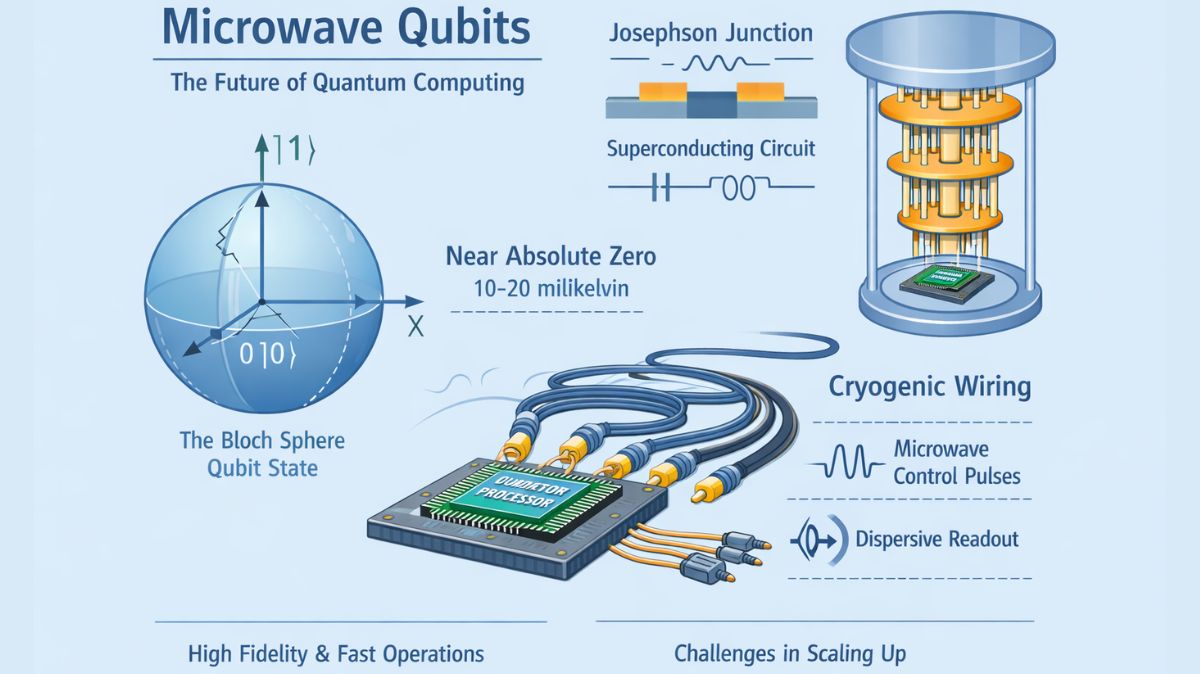
The Secret Sauce: The Josephson Junction
A study of the fundamental physics of superconductivity is necessary to comprehend the effectiveness of microwave qubits. Resistance causes heat and energy loss in a normal electronic circuit, but when some metals are cooled to millikelvin temperatures, resistance disappears and electrons form “Cooper pairs.”
Although energy can flow between a capacitor and an inductor in a typical superconducting circuit (LC circuit), this circuit has a serious drawback it is a harmonic oscillator. Because of the equal spacing of its energy levels, it is impossible to target only the first two levels, the 0 and 1, which are necessary for computation, without unintentionally causing the system to move into higher states.
To make a non-linear inductor, engineers sandwich two superconductors with a thin insulating layer. The ground state (|0⟩) and excited state (|1⟩) transitions are guaranteed to be distinct due to this nonlinearity, which “stretches” the energy levels. Because of this, scientists can “address” the qubit with a particular microwave frequency without interfering with the system as a whole.
The “Transmon” Standard
The Transmon qubit has become the industry standard, despite the existence of various alternatives, such as Flux qubits, which employ persistent currents, and Phase qubits, which employ phase differences.
“Charge qubits” were infamously erratic in the past and were easily disturbed by electrical background noise. The Transmon, developed by researchers, is extremely resistant to charge noise by incorporating a huge shunt capacitor. The coherence periods (the amount of time a qubit may retain its quantum information) were significantly extended from nanoseconds to hundreds of microseconds by this breakthrough.
You can also read SEALSQ News Today: PQC for Physical AI Infrastructure
Programming at Absolute Zero
These chips are a cryogenic engineering marvel. The smallest quantity of room-temperature heat would instantaneously cause the qubit to lose its state since microwave photons have extremely little energy. To avoid this, these processors are kept in dilution refrigerators that are kept at a temperature of between 10 and 20 millikelvin. At this temperature, the environment is in its “vacuum ground state,” which promotes the persistence of quantum superposition and reduces thermal noise.
It is possible to control these frozen qubits using Circuit Quantum Electrodynamics (cQED). In order to execute a logic gate, like a bit-flip (X gate), engineers pulse a precisely designed microwave at the resonance frequency of the qubit.
- How much the qubit “rotates” on the Bloch sphere the mathematical description of a qubit’s state depends on the pulse’s magnitude and duration.
- The axis of that rotation arises from the pulse’s phase.
Dispersive readout is a method used to “read” the results without making the quantum state unusable. A nearby resonator receives a microwave tone; consequently, the frequency of the resonator varies somewhat based on whether the qubit is in state 0 or 1. In order to ascertain the state of the qubit, scientists measure the phase shift of the reflected signal.
You can also read SoCal Quantum Alliance Boosts California Quantum Research
The Scaling Wall
The two most difficult challenges facing microwave qubits, notwithstanding their current dominance, are scaling and decoherence. Even in their extremely cold cradles, qubits eventually deteriorate because of electromagnetic interference, cosmic rays, or faults in the material. In an effort to prolong these lifespan, scientists are currently working with novel materials like tantalum.
The physical challenge that is more urgent is the “Wiring Heat” issue. For each qubit to transmit microwave pulses, many coaxial cables are currently needed. As we progress from 100-qubit computers to ones with one million, the heat produced by these miles of wire will be too much for even the most potent refrigerators to handle. In order to lessen the wire load, this is propelling the creation of “cryogenic CMOS” controllers, which are tiny devices that can accompany the qubits inside the refrigerator.
A Quantum Future
Microwave qubits are a powerful platform due to their nanosecond operation times, high gate fidelity (>99%), and compatibility with semiconductor production methods. Superconducting circuits are a cornerstone of quantum computing, but developing a fault-tolerant quantum computer is still a difficulty. Microwave qubits and optical technology may link quantum computers over long distances in future hybrid systems.

Thank you for your Interest in Quantum Computer. Please Reply