Quantinuum’s 2025: The Year of the Realization of Quantum Utility
Quantinuum News
As 2025 comes to an end, Quantinuum’s high-stakes discoveries have completely changed the landscape of quantum computing. As the company moved past the days of experimental “toys,” it demonstrated throughout the year that quantum technology could not only surpass traditional supercomputers in performance but also be easily included in the global AI revolution.
This article breaks down Quantinuum‘s historic 2025, from the Helios processor’s commercial introduction to a groundbreaking advancement in Quantum Error Correction (QEC).
Overcoming Error Correction’s “Magic State” Barrier
Researchers at Quantinuum declared that they have solved the “last major hurdle” to scalable quantum computing in June 2025. They showed off a completely fault-tolerant universal gate set with repeated error correction for the first time.
The innovation was based on Magic State Distillation. Clifford gates are simple to fix, but “non-Clifford” gates, which are necessary for universal computing, are infamously challenging. With a 10x improvement in magic state fidelity (7X10⁻⁵), Quantinuum demonstrated that their roadmap to a fully fault-tolerant system by 2029 is now “de-risked.”
You can also read Quantum technology marketing outlook 2035: CAGR, market size
Quantum Generative AI (GenQAI)
The unveiling of the Generative Quantum AI framework in February was arguably the most widely reported event of the year. By demonstrating that data produced by their H2 processor could be utilized to train AI models, Quantinuum greatly increased the fidelity of those models.
- Commercial Impact: Helios is already being used by businesses including BMW Group, JPMorganChase, and Amgen to address financial modelling, material design, and medication development.
- The “Hive” Platform: Quantinuum and Hiverge jointly unveiled “The Hive,” an AI-powered platform that uses sophisticated chemistry to automatically find new quantum algorithms.
International Growth: Japan, Qatar, and Singapore
Quantinuum’s 2025 was also characterized by significant geopolitical changes:
- Singapore Partnership: Through a strategic agreement with the National Quantum Office of Singapore, a Helios system will be installed in Singapore by 2026, making it the first nation outside of the United States to house this top-tier hardware.
- Qatar Joint Venture: To hasten the deployment of quantum technology in the Middle East, Quantinuum and Al Rabban Capital established a joint venture in May.
To create the “Quantum Data Center” of the future, a ground-breaking collaboration with SoftBank Corp. was formed.
You can also read DeepQuantum: Unifying 3 Paradigms Of Quantum Computing
The Valuation of $10 Billion
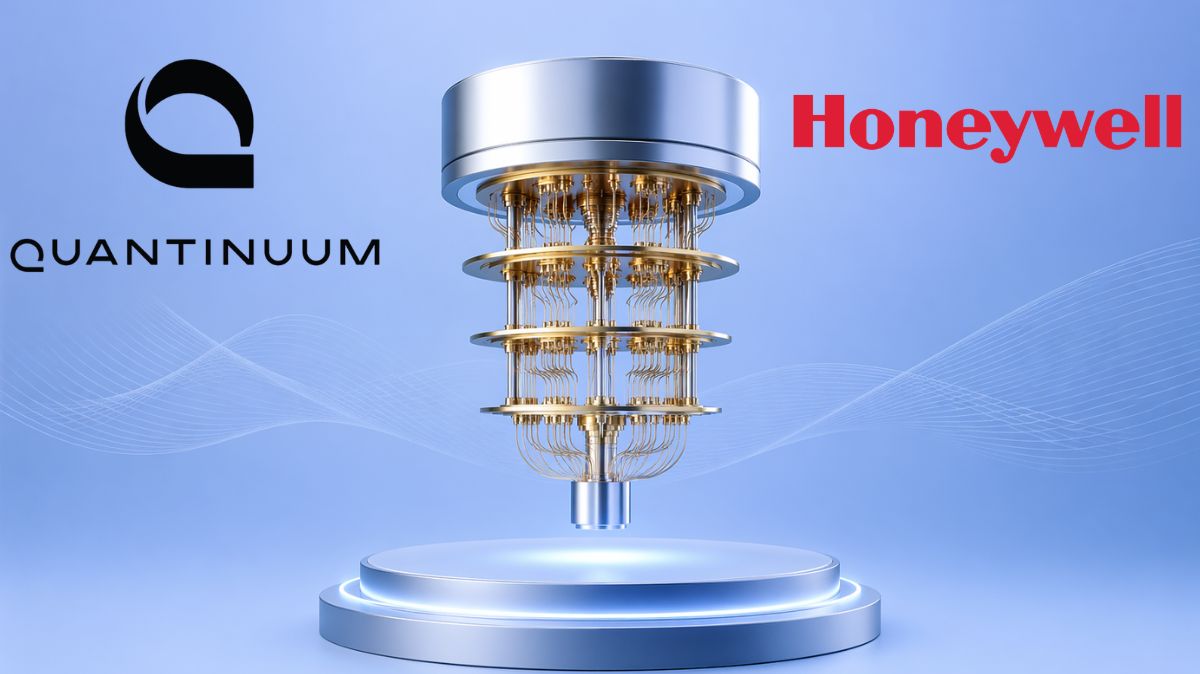
These technical achievements were noticed by the financial community. Honeywell spearheaded a $600 million capital offering for Quantinuum in September 2025, with Fidelity International joining in. As a result, the company’s valuation skyrocketed to an astounding $10 billion, solidifying its position as the clear industry leader in integrated quantum.
Helios: The World’s Most Accurate Quantum Computer
Helios, Quantinuum’s next generation trapped-ion quantum computer, was formally introduced in November 2025. Helios, in contrast to earlier systems, was designed for commercial application rather than primarily for research.
- Unprecedented Fidelity: Helios broke the two-qubit gate fidelity record, exceeding the crucial “three 9s” (99.9%) criterion across the system.
- The Hybrid Engine: Helios enables developers to program quantum processors in addition to traditional GPUs with its unique real-time control engine.
- Quantinuum integrated Helios with the NVIDIA GB200 via NVQLink and produced Guppy, a Python-based language. This makes it possible for hybrid workflows and real-time error correction, which were previously unattainable.
Quantinuum is chosen by DARPA for Stage B Benchmarking
Quantinuum was chosen by the U.S. Defense Advanced Research Projects Agency (DARPA) to move on to Stage B of its Quantum Benchmarking Initiative, which is a performance-based assessment aimed at utility-scale quantum computing by 2033. This included the rigorous R&D planning and scaling assumption validation of the “Lumos” system.

Thank you for your Interest in Quantum Computer. Please Reply