Quantum computing is rapidly advancing in 2026, affecting cybersecurity and healthcare. It is no longer a fringe concept for research labs. As the subject develops, there is an unprecedented need for developers who are familiar with quantum programming languages, which are the means by which humans can communicate with quantum machines. This year, as sectors like banking and artificial intelligence are ready for a full-scale quantum revolution, quantum programming is altering how we solve complicated issues. Comprehending these languages is now regarded as an increasingly important ability for any developer hoping to remain at the forefront of the field.
You can also read QC Design Launches Gauge for Optimal QEC Benchmarking
Bits vs. Qubits
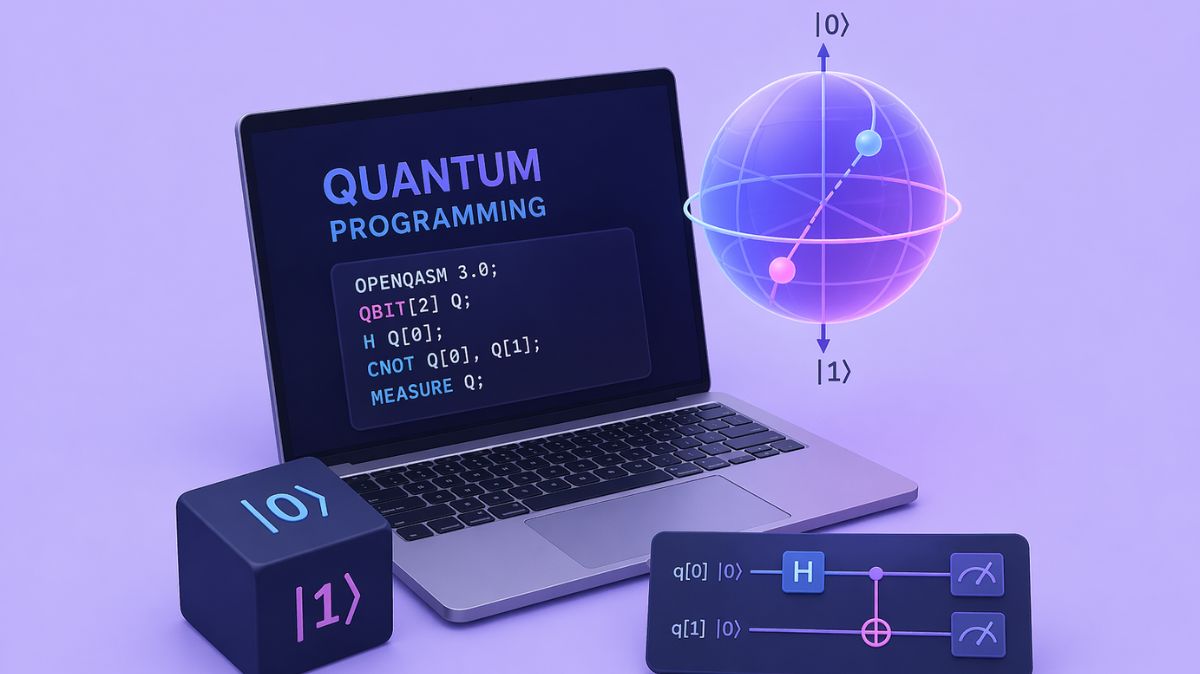
Quantum programming languages write qubit-based quantum computer instructions. Quantum programming uses quantum mechanics, while classical uses binary logic. Qubits can exist in numerous states due to superposition and entanglement, unlike conventional computing.
Because of this, quantum programs are probabilistic, while classical calculations are deterministic with predictable results. When measured repeatedly, qubits collapse into specified states, producing a quantum program’s output. These features allow programmers to develop quantum circuits and use algorithms that may outperform classical computers, such as Grover’s database searching algorithm or Shor’s huge number factoring technique.
You can also read BTQ news today hires Dr. Muraleedharan as quantum researcher
From Assembly to High-Level Abstraction
The quantum ecosystem expanded rapidly by 2025, with over 37 quantum languages and frameworks. In 2026, programming tools had three tiers:
- Low-Level Instruction Sets: These provide gate-level instructions for quantum processors and function as the assembly languages for quantum hardware. Examples of systems that convert algorithms into physical operations carried out by qubits are OpenQASM (IBM), Quil (Rigetti), and Blackbird (Xanadu).
- Software Development Kits (SDKs): SDKs are the most popular entry points for beginners since they simplify hardware. Python programmers can use SDK libraries and simulators to test their code.
- High-Level Quantum Languages: These are specially designed languages with quantum-native syntax, such Silq and Microsoft’s Q#, that provide more abstraction and security when creating intricate algorithms.
You can also read Q NEXUS By Q-CTRL: Heterogeneous Quantum Architecture
The Market Leaders: IBM, Microsoft, and Google
In the landscape of 2026, a number of platforms have become leaders. IBM’s Qiskit framework continues to be the most popular and industry standard. It is very accessible to the millions of developers who are already familiar with Python because it is built on that language. It is the best place to start for novices since it provides a robust ecosystem for machine learning, optimization, and simulation.
A different strategy is provided by Microsoft’s Q#, a high-level, domain-specific language created just for quantum computing. It offers powerful debugging and resource estimation capabilities and works with the Azure Quantum platform. Google’s Cirq, on the other hand, is designed for creating circuits that operate on actual processors, such as the Sycamore chip, providing fine-grained control that is particularly useful for research and hybrid quantum-AI applications.
PennyLane has emerged as a crucial tool for combining quantum circuits with traditional machine learning models for those seeking to bridge the gap between AI and quantum. Additionally, developers may execute algorithms across many hardware suppliers without requiring their own specific infrastructure with cloud-based platforms like Amazon Braket and BlueQubit.
You can also read MIT quantum computing news: MIT chip secures medical devices
The “Noisy” Reality and Career Opportunities
While promising, quantum programming confronts obstacles in 2026. NISQ hardware is error-prone and limited. Probabilistic quantum algorithms make debugging tougher. Developers must deal with abstract paradigms different from sequential classical logic.
However, enrollment in quantum training is rising because to the professional incentives. According to studies, 70% of quantum job advertisements currently demand Python expertise, and the market for quantum computing is expected to reach $20 billion by 2030. The opportunity to work on “unsolvable” issues like drug development, molecular simulation, financial modeling, and sophisticated cryptography attracts developers in addition to financial gain.
You can also read Quantinuum News Expands Globally for preparing Landmark IPO
Looking Ahead
Higher-level abstractions and AI-assisted development tools are trending in the subject as 2026 goes on, with the goal of making quantum programming understandable to non-experts. Even if there is still a steep learning curve, current technologies like Qiskit, Q#, and several cloud simulations are helping to close the gap. The developer of 2026 believes that becoming proficient in these languages now will put them at the forefront of the next major computing revolution.
You can also read QC Ware 5th Quantum Q2B Tokyo 2026 Dates Announced


Thank you for your Interest in Quantum Computer. Please Reply