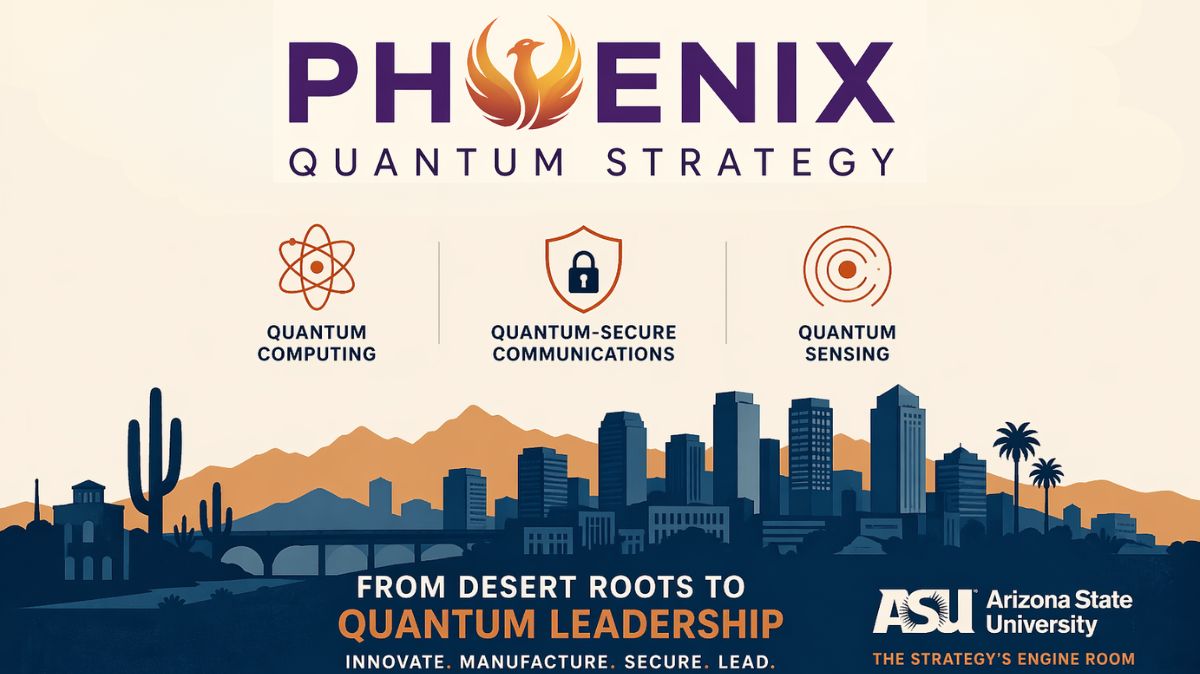
Mayor Kate Gallego’s 2026 State of the City speech before a packed Phoenix Convention Center of corporate leaders and legislators changed the region’s economic trajectory. Phoenix is “building the infrastructure to host it” rather than just “chasing the future,” the mayor said, unveiling the Phoenix Quantum Strategy, a public-private partnership to capture a large piece of the $1 trillion quantum economy.
The plan reflects the organic development of a city that has spent a century evolving from an agricultural outpost in the desert to a major player in the world of technology. Phoenix is marketing itself as the location where these theoretical “miracles” become scalable, manufacturable realities, despite the fact that the world has traditionally connected quantum computing with experimental physics and academic theory.
A Foundation Built on Silicon
The enormous semiconductor bedrock of the metropolitan area is the cornerstone of this new approach. during $100 billion has been invested in semiconductors in the “Silicon Desert” during the past five years, primarily from Taiwan Semiconductor Manufacturing Company (TSMC). Because quantum computers need specialized hardware that uses the same cutting-edge materials and precision engineering already found in the Valley, this current environment offers a significant advantage.
Important suppliers like Lam Research have already built a national training facility close to the TSMC location, creating hundreds of well-paying jobs and solidifying the area’s proficiency in wafer production. Phoenix hopes to establish a “full-stack” tech corridor that includes everything from raw silicon to sophisticated quantum algorithms by combining quantum research with this local chip manufacturing capability. Local businesses are already making contributions to early supply chains by manufacturing the high-purity silicon and tailored materials needed to construct qubits, the basic building blocks of quantum computing.
The Three Pillars of the Quantum Strategy
Three main technological pillars form the foundation of the Phoenix Quantum Strategy, which aims to update the city’s municipal and industrial infrastructure:
- Quantum Computing: The city will create “Quantum-as-a-Service” (QaaS) hubs in collaboration with commercial companies and Arizona State University (ASU). Local startups and well-established sectors like logistics and aerospace will be able to access quantum processing power through these hubs without having to pay exorbitant maintenance expenses for cryogenically cooled hardware.
- Quantum-Secure Communications: The city is giving “Post-Quantum Cryptography” a priority after realizing that quantum computers pose a threat to conventional encryption. Quantum-resistant techniques created in partnership with ASU’s Quantum Lab in Tempe will be used in a new pilot program to secure utility grids and municipal data.
- Quantum Sensing: Using quantum states to develop extremely sensitive sensors is the main goal of this pillar. In the Phoenix Biomedical Core, where $50 million was just spent in new technical and medical facilities to detect diseases before symptoms even develop, this has urgent applications.
Phoenix Advantage: Manufacturing First
Phoenix focuses on manufacturing, unlike Silicon Valley, which focuses on software and venture-backed enterprises. Historical examples in the semiconductor and aerospace sectors show that areas that can build systems at scale often succeed, not those that made the discovery.
The ability to develop and implement technology, according to experts, is the true arena for quantum dominance. Phoenix’s approach makes use of its expertise in epitaxial wafer growth and photonic chip production, two processes that are challenging to duplicate in areas without an industrial basis. The objective is for Phoenix to develop into a crucial hub in the global ecosystem, where quantum technologies are developed, improved, and implemented.
ASU: The Strategy’s “Engine Room”
A key component of this industrial change is academic institutions. The Mayor’s proposal’s “engine room” is ASU’s new Quantum Computing Laboratory. Researchers are developing quantum repeaters and single-photon detectors for quantum networks.
The university prioritizes workforce development in addition to research. Labs are now creating algorithms to simulate novel materials for electric vehicle batteries, a crucial business for Arizona, according to Dr. Sally C. Morton, executive vice president of ASU’s Knowledge Enterprise. The tactic serves as a link, transforming these scholarly discoveries into profitable ventures.
Democratizing High-Tech Labour
With economists projecting the creation of up to 15,000 high-tech jobs over the next ten years, the economic ramifications are significant. Crucially, Ph.D. physicists are not the only ones qualified for these positions. To prepare a workforce capable of maintaining the intricate vacuum systems and specialized cooling needed by quantum gear, the effort incorporates vocational training programs at nearby community colleges.
The “democratization of high tech,” according to Chris Camacho, President and CEO of the Greater Phoenix Economic Council, ensures that high-paying jobs into the 2030s and 2040s are based in Maricopa County.
Global Competition and Strategic Stability
Phoenix is vying with new hubs in Seattle, Chicago, Europe, and India in a global contest. But according to city officials, the Valley has two special benefits: stability in the environment and physical space. Phoenix has the space for enormous data centers and a steady climate free from frequent natural catastrophes, which is necessary for sensitive, extremely stable quantum technology, in contrast to the congested tech hubs of the Northeast or Silicon Valley.
The foundation being laid today is viewed as a long-term wager on ongoing growth, even if experts warn that widespread commercial use of quantum systems may be years away due to difficulties in error correction and scalability.
Looking Toward the Qubit Era
Phoenix will hold the first “Southwest Quantum Summit” in late 2026, inviting international researchers and venture capitalists to explore the Valley’s expanding infrastructure in an effort to sustain this pace. The city’s transition from “bits and bytes” to “qubits” represents a turning point. Phoenix’s quiet metamorphosis into a quantum manufacturing powerhouse may turn out to be the most important development in the future of global computing as the industrial focus moves from theoretical milestones to practical execution.


Thank you for your Interest in Quantum Computer. Please Reply