Nokia Bell Labs hopes to make a breakthrough in the search for a “unbreakable” quantum bit by 2026.
By Technology Correspondent
A fundamental weakness at the core of the technology has long hindered the industry in the high-stakes race to create a working quantum computer. Although quantum computing has the potential to transform a variety of industries, including global logistics and pharmaceutical research, by producing molecular-level digital twins and sophisticated optimization solutions, the hardware is still erratic. Due to the inherent instability of qubits, contemporary quantum systems require massive redundancy, which hinders brute-force engineering. However, with the creation of topological qubits, scientists at Nokia Bell Laboratories think they have discovered a route toward a more stable, useful future.
You can also read What Is A CNOT Gate Quantum Computing (Controlled Not gate)
The Instability Crisis
The fundamental component of a quantum computer is a qubit, also known as a quantum bit. It functions similarly to a transistor in a conventional microprocessor but is capable of doing computations that are well beyond the capabilities of classical computers. To develop a functioning computer, scientists must entangle thousands of these bits. Existing qubits are notoriously unstable, causing data to decohere and become meaningless noise with even a little vibration, temperature change, or electromagnetic field. The functional life of a qubit is measured in milliseconds in many modern systems.
Today’s quantum computers need hundreds of thousands of qubits merely to make sure a handful can stay stable enough to function to make up for this fragility. This “brute-force” strategy has produced enormous, building-sized devices that are as complicated as the most potent supercomputers in the world and require billions of dollars in maintenance.
You can also read MS Gate Offers Thermal Stability and Cross-Platform Quantum Compatibility
A Topological Revolution
This engineering-heavy strategy is being abandoned by Nokia Bell Labs, which is instead concentrating on the basic physics of maintaining quantum states. The Nobel Prize-winning fractional quantum Hall effect discovery and decades of condensed matter physics study are being used to create a topological qubit.
This new qubit uses topology, which studies how geometric objects retain their properties despite being stretched, twisted, or warped. Researchers use a coffee cup with a handle as an example: it has a hole. As long as you don’t rip it, the topology stays the same—it is still a vessel with a hole—even if you stretch the handle or lengthen the cup’s cylinder.
By using this in the context of quantum physics, Nokia Bell Laboratories is developing a system that maintains computational capabilities even in the face of external “contortions”. These topological states are essentially robust, in contrast to conventional qubits, which might collapse at the smallest disruption. Principal Researcher Robert Willett claims that accidently altering a particle’s quantum state is highly challenging as it necessitates a very precise, deliberate action.
You can also read Magic-Augmented Clifford Circuits In Quantum Computing
Braiding
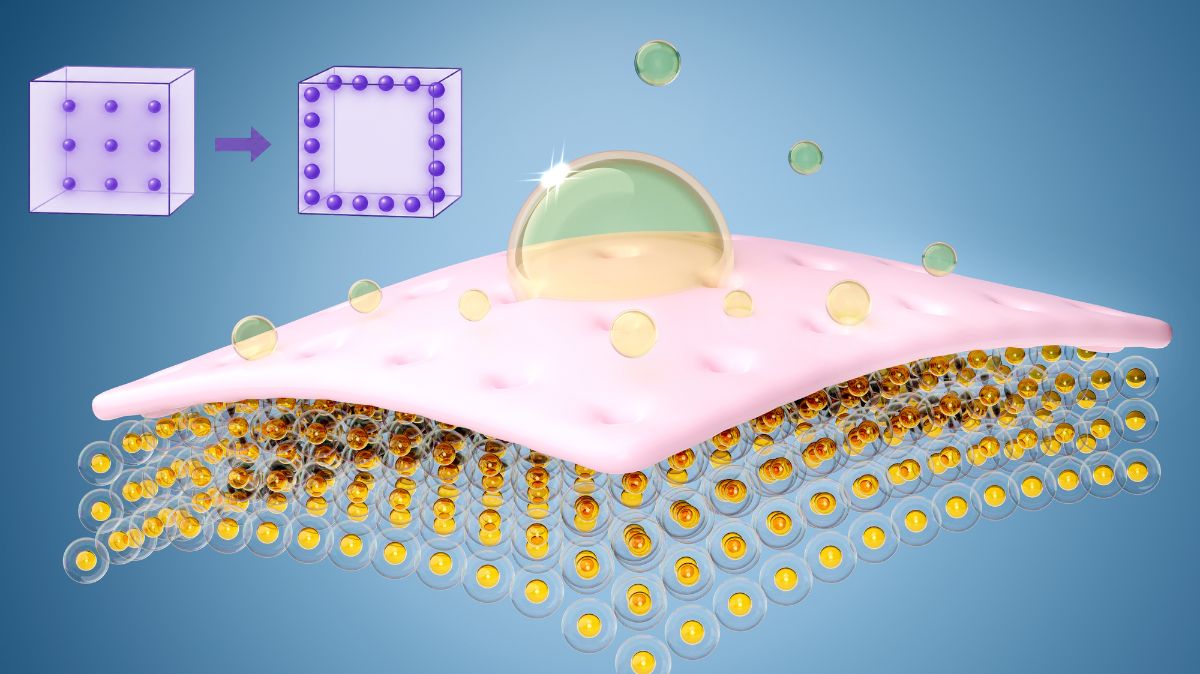
The creation of a supercooled electron liquid, which acts as a “canvas” for the quantum activities, is the technological implementation of this idea. The researchers “paint” qubits onto this surface by using electromagnetic waves. They then employ a technique called braiding to move charges around one another using extra fields.
This braided arrangement functions as a topological state switch. The quantum states are incredibly stable since they are almost “locked” into this braided pattern. Nokia Bell Labs anticipates that its topological qubits will function for hours, days, or even weeks, whereas conventional qubits only last milliseconds. Because of its robustness, conventional disruptors like temperature changes or stray particles have virtually little effect; even if a single charge is disrupted, the entire topology stops the chain reaction of mistakes that usually afflict quantum systems.
You can also read Ancilla Qubits: Reliable and Scalable Quantum Computing
The 2026 Roadmap
Only two businesses are now following this particular topological approach, and Nokia has set a precise deadline for demonstrating the technology’s feasibility. In 2023, the group accomplished their first significant milestone by convincingly proving that they could control a single charge inside a topological quantum state.
The research’s next stage is scheduled for 2025. The team hopes to create a quantum NOT gate by the first part of the year. The most fundamental component of every computer system is a NOT gate, which switches a bit from a 0 to a 1. This would demonstrate that the topological qubit satisfies the fundamental requirements for a quantum computer. They want to show more sophisticated quantum computing functions in the second half of 2025.
The ultimate objective is to demonstrate a stable, fully functional topological qubit by 2026. With this accomplishment, theoretical research would give way to the development of scalable quantum devices.
You can also read New Fault-Tolerant Clifford Gates Improve Quantum Computing
Reducing the Quantum Impact
A successful topological qubits has significant ramifications, especially for the size and price of future computers. According to Michael Eggleston, Head of Data and Devices Research at Nokia Bell Labs, “the topological qubit will give the industry a much more practical and economical option,” since these qubits don’t need the massive redundancy of existing designs due to their incredibly low error rates. In his ideal future, a silver dollar-sized container might contain a million qubits. A topological quantum computer with comparable power may fit inside a typical server rack for millions of dollars, as opposed to a building-sized device that would cost billions.
The topological qubits, according to Nokia Bell Labs, may be the crucial finding that ultimately propels computers from the digital era into the quantum era, just as the transistor, another Bell Labs invention, helped to bridge the gap between the analog and digital eras.
You can also read Improving Logical Gate Efficiency in Quantinuum Logical Qubits
what is a topological qubit
A topological qubit is a highly stable, error-protected type of quantum bit (qubit) that stores quantum information in the nonlocal, structural properties (topology) of quasiparticles, such as Majorana zero modes, rather than in fragile individual particle states. By manipulating, or “braiding,” these exotic particles, computations become immune to local noise, theoretically enabling much longer coherence times and easier error correction compared to traditional superconducting or spin qubits.
Thank you for your Interest in Quantum Computer. Please Reply