The non Hermitian skin effect is transforming quantum physics by redefining boundary behavior and system dynamics.
Noise has long been considered the greatest enemy in the conventional landscape of quantum physics. Decoherence, the destruction of delicate superpositions, and a general decline in quantum processor performance are all caused by this chaotic force. But a ground-breaking work by Peking University physicists Wuping Yang and H. Huang is upending this paradigm. According to their findings, perfectly calibrated noise can actually operate as a restorative factor, bringing directed particle movement back to life in materials where disorder had previously inhibited it.
You can also read MIT.nano setup advanced system for Quantum Material research
Breaking the Paradigm: Noise as a Restorative Force
A novel mechanism for regulating transport in open quantum systems is revealed by the team’s discoveries, which were recently brought to the attention of the scientific world. The researchers discovered that they could “unlock” energy mobility in complex systems that were previously believed to be functionally “dead” to transport by adding a certain kind of correlated randomness. This “Quantum Resurrection” offers a revolutionary toolbox for the construction of next-generation photonics and quantum circuits by implying that the boundary between order and chaos is not only thin but also functional.
The Mechanics of Drift: Understanding the Skin Effect
The Non-Hermitian Skin Effect (NHSE) and its dynamical cousin, the Dynamical Skin Effect (DSE), must be understood to comprehend how noise can be advantageous. Systems in classical quantum physics are usually “Hermitian,” which means that energy is conserved and the system’s evolution is balanced. But “non-Hermitian” systems, which interact with their surroundings by gaining or losing energy, exhibit far more bizarre behavior.
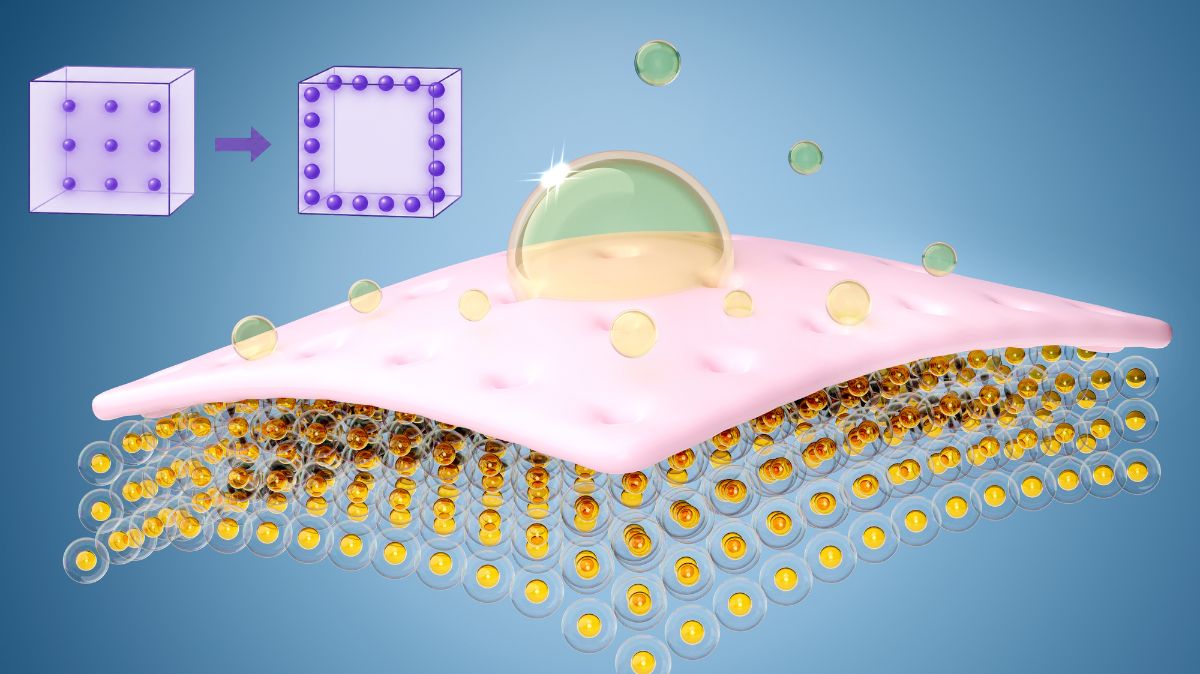
An enormous number of quantum states (eigenstates) cluster or “pile up” near a material’s physical boundaries in these non-Hermitian systems. The NHSE is this. A wave packet of energy delivered into such a system exhibits a directed “drift” toward the edge and eventually accumulates near the border rather than spreading out uniformly. The term “Dynamical Skin Effect” refers to this accumulation and directional motion.
You can also read QFAMES Algorithm Uses Quantum Energy Spectrum Analysis
The Wall of Disorder: Why Quantum Transport Fails
The DSE offers a natural way to transfer energy, it is infamously brittle. Movement is impeded in real-world materials by “disorder” imperfections in the atomic lattice. The researchers specifically examined organized but imperfectly repeating quasiperiodic potentials. A state known as localization, in which a particle’s wave function becomes trapped in a tiny area of the material, is known to be induced by these potentials.
The particle can no longer “drift” to the edge once localization takes hold; the disorder essentially eliminates the DSE. For many years, physicists thought that the directional transport promised by non-Hermitian physics would remain unattainable if a material was too disordered, placing a fundamental restriction on the design of quantum materials.
You can also read Nokia Bell Labs’ Unbreakable Topological Qubits Approach
Ornstein-Uhlenbeck Noise: The Correlated “Lubricant”
By posing the paradoxical query, “Could noise be used to fight disorder?” the Peking University team questioned this constraint. They employed a one-dimensional non-reciprocal Aubry-André-Harper model, a common framework for researching particle navigation in quasiperiodic environments, to test this.
Their utilization of Ornstein-Uhlenbeck (OU) noise was crucial to their success. OU noise has a “memory” of its past state since it is correlated over time, in contrast to normal “white noise,” which is entirely random at all times. This distinction is crucial because white noise would probably make localization worse rather than better. The complicated, non-Hermitian dynamics of the system were mapped onto a more manageable non-reciprocal master equation by the researchers using a mathematical method known as perturbative analysis.
You can also read Ravitej Uppu Iowa, Introduces High-Precision Quantum Dot
The Point Gap Discovery: Bridging the Energy Spectrum
The analysis’s findings were astounding. The scientists from Peking University showed that the addition of OU noise produces a “point gap” in the energy spectrum of the system. Wave functions can “escape” their limited traps and resume their directed motion with this spectral property, which serves as a bridge.
The addition of calibrated noise (at a level of about 10 in their model) reversed the localization in regimes where the quasiperiodic potential was high enough to entirely stop particle movement. Compared to earlier techniques, which were unable to revive the DSE above a certain quasiperiodic strength, this was a more than five-fold improvement. Wave packets were able to drift toward the boundaries even in the absence of the static non-Hermitian skin effect because the noise effectively “lubricated” the system.
You can also read Fermilab Quantum, NIU launch quantum science master program
A Delicate Balance: The Cost of Delocalization
The researchers warn that noise is not a “free lunch” despite the experiment’s success. The “Noise-Transport Duality” is a basic trade-off.
- The Delocalization Phase: At certain intensities, noise fractures the quasiperiodicity chains, enabling the flow of energy.
- The Decoherence Phase: Massive decoherence, or the loss of quantum information, is brought on by excessive noise.
At this point, the quantum advantages that researchers are trying to exploit are destroyed as the system starts to act like a fully classical, chaotic jumble. Finding the “sweet spot” where noise is loud enough to allow motion yet quiet enough to maintain quantum coherence is the significance of the Peking University work.
Charting the Future: From Photonics to the Quantum Internet
As a approach large-scale quantum deployment in the early 2030s, the capacity to restore energy transport despite material disorder has significant implications for a number of technological domains.
- Robust Photonic Devices: Light-based photonic circuits are extremely susceptible to manufacturing flaws. Engineers may be able to guarantee that light signals reach their destination even in defective circuits by using “stochastic driving” or calibrated noise.
- Energy Harvesting: Directional conveyance is crucial for materials intended to harvest thermal or solar energy. According to this research, energy might be moved to collecting sites more effectively by utilizing ambient “jitter” than in absolutely “quiet” systems.
- Quantum Networking: Long-distance signal transmission via fibers and repeaters is necessary for a worldwide quantum internet. New techniques to prevent these signals from being caught by disorder-induced localization may result from an understanding of how noise interacts with the NHSE.
Ultimately, Yang and Huang’s study changes material science. Instead of considering noise as an irritation to be avoided, scientists can now use it to discover the latent potential of non-Hermitian materials and transcend chaos.
You can also read QuSecure Secures Double Victory at 2026 Stevie Awards

Thank you for your Interest in Quantum Computer. Please Reply