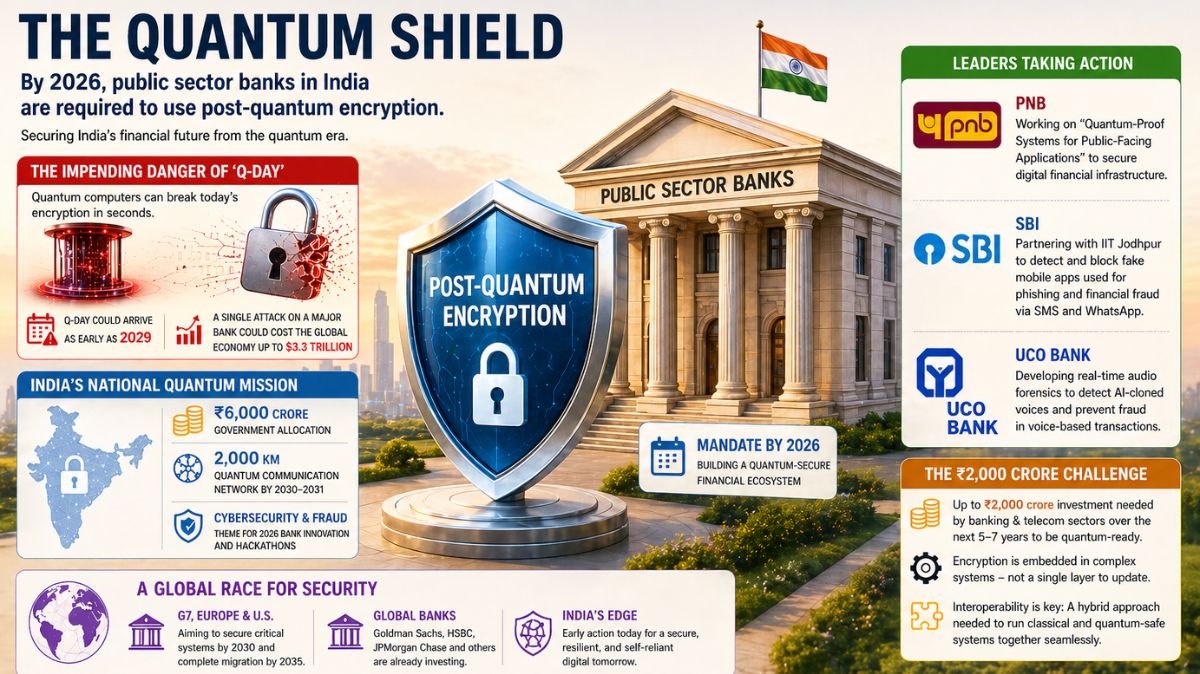
The Quantum Shield: By 2026, public sector banks in India are required to use post-quantum encryption.
The Union Finance Ministry has ordered public sector banks (PSBs) to switch to quantum-resistant encryption to secure the country’s financial system against technological disruption. As India prepares for “Q-Day”—the day quantum computers potentially compromise digital security, this rule, part of the 2026 innovation and security plan, changes its cybersecurity strategy.
You can also read Rigetti Computing India Quantum Collaboration Boosts Quantum
The Impending Danger of “Q-Day”
Cryptographic technologies such as elliptic curve cryptography and RSA are the mainstay of modern banking security. Even though traditional supercomputers are now unable to access these systems, quantum machines’ exceptional processing capacity may make them obsolete. Experts caution that the most complex encryption systems in use today may be broken in a matter of seconds by a suitably competent quantum computer.
According to National Quantum Mission (NQM) projections, “Q-Day” may occur as early as 2029. The stakes are extremely high; according to a Citi Bank analysis, the economy may suffer an indirect loss of up to $3.3 trillion from a single successful quantum attack on a big global bank. The government wants to make sure that important documents, payment networks, and consumer data are safe before these devices become a reality, so it is pushing banks to investigate post-quantum cryptography (PQC) immediately.
India’s National Quantum Mission and Strategic Reaction
The change is a key component of India’s larger cybersecurity “Aatmanirbhar Bharat” effort. The National Quantum Mission, charged with constructing a 2,000-km quantum communication network by 2030–2031, has already received ₹6,000 crore from the government.
The Finance Ministry has designated “Cybersecurity and Fraud” as the main issue for hackathons and bank-led innovation in 2026 under this framework. Banks are increasingly required to analyze practical implementation tactics, such as testing new encryption standards and evaluating their integration into intricate IT settings, rather than only doing theoretical research.
You can also read SEALSQ Latest News: India Adds Post-quantum Semiconductors
Public Sector Banks in India: UCO Bank, SBI, and PNB
To fulfill these new requirements, a number of significant lenders have already started experimental initiatives. “Quantum-Proof Systems for Public-Facing Applications” is a project that Punjab National Bank (PNB) is leading to safeguard its digital financial infrastructure.
In the meanwhile, the Indian Institute of Technology (IIT), Jodhpur, and the nation’s biggest lender, State Bank of India (SBI), have cooperated. The goal of this partnership is to eliminate phony mobile apps that enable financial fraud and phishing, which are frequently disseminated through SMS or WhatsApp.
UCO Bank, located in Kolkata, is creating a real-time audio forensics module as an alternative security strategy. To identify fraudsters utilizing AI-cloned voices, a growing concern where criminals use speech biometric passwords to transfer money illegally, this technology examines the spectrogram of live conversations.
You can also read CERT-In: Safeguarding India’s Cybersecurity Infrastructure
The ₹2,000 Crore Task
Despite the obvious need, there are several technological and financial obstacles in the way of a quantum-secure banking industry. According to industry estimates, India’s telecom and banking industries could need to invest up to ₹2,000 crore to become “quantum-ready” over the next five to seven years.
The technological difficulty derives from the fact that encryption is firmly ingrained in several applications, ATM networks, cloud services, and data centers rather than being a single “layer” that can be readily updated. Tech policy expert Subimal Bhattacharjee highlights that before banks can effectively transition to new standards, they must first determine where these outdated systems are located.
Interoperability is also a significant issue. To avoid service interruptions throughout the transition, new quantum-safe algorithms must coexist with current conventional systems. To preserve stability, this would necessitate a “hybrid” strategy in which organizations use both classical and quantum-resistant techniques concurrently.
You can also read Indian Indigenous Quantum Testbeds Launched in Amaravati
A Worldwide Race for Security
India’s initiative is consistent with a worldwide trend. Ambitious goals have been established by regulators in the G7, Europe, and the United States. Many of them want to safeguard vital systems by 2030 and finish the migration by 2035. Global financial behemoths including Goldman Sachs, HSBC, and JPMorgan Chase have already started their own initiatives to reduce quantum risks.
India is preparing its public sector banks to meet future problems by implementing these measures now. The Finance Ministry’s decree is more than simply a standard update; it acknowledges that the future of financial stability rests on more intelligent, forward-thinking security measures in an increasingly digital environment. Indian politicians are making it very evident that adopting quantum-resistant encryption is now required as the world’s race toward quantum computing picks up speed.
You can also read Quantum Valley Tech Park to Train 100,000 Developers by 2030



Thank you for your Interest in Quantum Computer. Please Reply