Silicon photonics is seen as the key technology to get over the present scaling constraints in quantum computing, which is quickly progressing from theoretical study to real-world, large-scale deployment. Superconducting circuits and other matter-based qubits have long been the foundation of traditional quantum systems, but manufacturers are increasingly turning to photons to help close the gap between small-scale prototypes and commercially feasible, million-qubit machines.
You can also read University of Rochester News: Gets to $2M Quantum Fund
An Upcoming Standard for Architecture
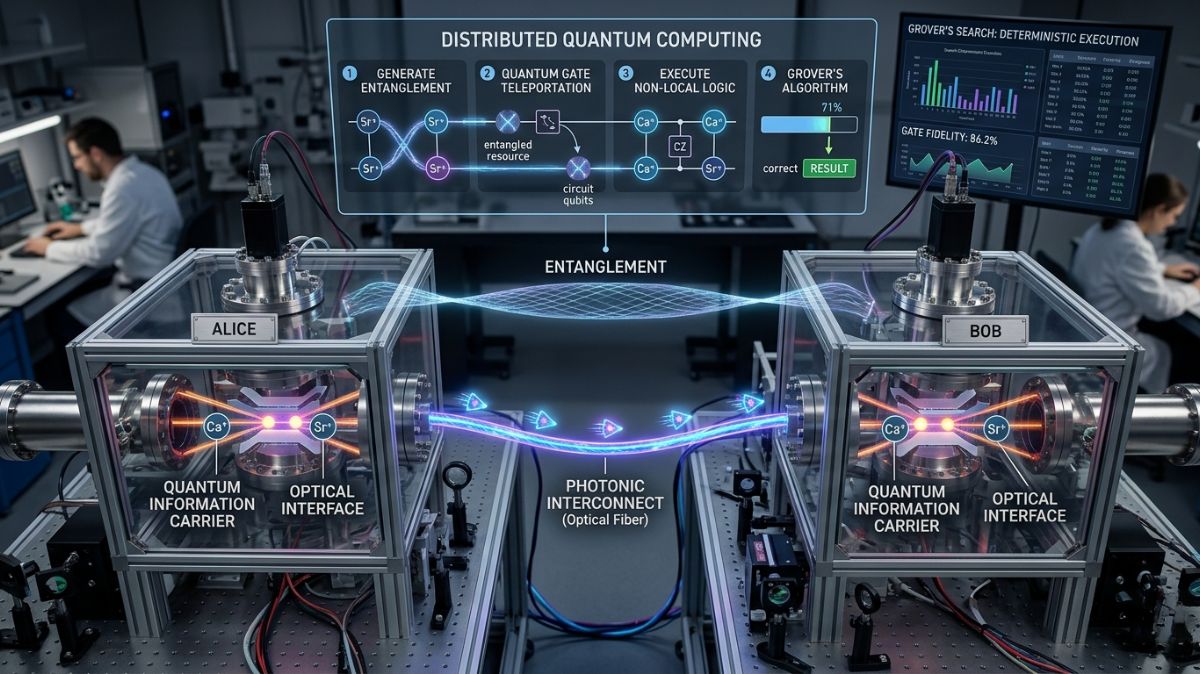
Through the use of tiny optical circuits to direct and control photons rather than electrical signals, silicon photonics aims to integrate light-based components directly onto silicon chips. Due to photons’ inherent resistance to external noise a recurring obstacle in quantum electronics that causes decoherence this change is noteworthy. The fragile condition of entanglement needed for intricate calculations can be preserved by researchers by employing light to accomplish high-fidelity transfers of quantum states with little interference.
There is less energy loss with photonic systems than with conventional copper-based electronics, which have huge resistive losses and produce a lot of heat. Silicon photonics is already a major force in data centers and telecommunications, and it is currently being modified for the upcoming generation of quantum processors mostly because of its efficiency.
Resolving the Problem of Scaling
In quantum computing, scaling systems to accommodate thousands or even millions of qubits is one of the most difficult problems. Conventional systems based on matter need complicated, large wiring that is difficult to grow. Silicon photonics, on the other hand, uses optical waveguides to create dense, low-loss interconnects. Large numbers of qubits can be connected by these waveguides across several chips, creating the “quantum interconnects” required for a scalable, modular design.
The method also makes use of CMOS manufacturing’s established infrastructure. Because of their compatibility, photonic quantum devices can be mass-produced using current techniques for fabricating semiconductors, which significantly reduces production hurdles and facilitates the transfer from lab to manufacturing.
You can also read Leibniz Supercomputing Centre LRZ Launches Euro-Q-Exa
Advantage of Efficiency: Light vs. Electrons
Comparing a light-based method to conventional copper-based electronics reveals significant technical advantages. Industry data indicates that photonics enables faster signal propagation and a significantly larger bandwidth (in the Terahertz range as opposed to Gigahertz for electronics).
Photons can function as “flying qubits,” enabling safe quantum communication over greater distances. This is perhaps the most significant development for the “quantum internet” of the future. Current efforts are focused on developing silicon devices for quantum key distribution (QKD), which is necessary to construct a safe and useful quantum network.
A comparison of the two platforms demonstrates the reasons behind the industry’s change:
- Energy Efficiency: Photonics possesses no resistive heating and negligible loss, whereas electronics produce heat through resistive losses.
- Cooling Needs: For many matter-based qubits, intense cryogenic cooling is necessary. Many photonic devices, on the other hand, may function at ambient temperature or close to it, which drastically lowers the cooling overhead for hybrid architectures.
- Scalability: Electrons are constrained by heat dissipation and crosstalk, but photonics can be readily parallelized by wavelength-division multiplexing.
Worldwide Impulse and Utility-Scale Goals
There is now a global rivalry for quantum dominance. Researchers and nations are now introducing photonic quantum processors that can accelerate difficult workloads by thousands of times. Businesses of all sizes are making significant investments in these platforms to create machines that can withstand errors.
Often called “utility-scale” quantum computing, the million-qubit machine is the ultimate target for many businesses. Eventually, these enormous systems might be able to fit into typical data-center-like settings by substituting photonic designs for conventional cryogenic architectures. This would make them more accessible for industrial uses in cryptography, artificial intelligence, and drug discovery.
You can also read Quantum Capacitance Enables Readout of Majorana Qubits
Technical Difficulties on the Way Ahead
Despite the excitement, silicon photonics still faces several technological obstacles before it can truly establish itself as the industry standard. For researchers, producing identical, on-demand single photons at scale is still a challenging issue. Furthermore, although combining electronics and optics on a single chip has its benefits, it also presents challenging fabrication and heat management problems.
Despite this, quantum error correction is still a resource-intensive procedure in photonic systems. According to industry opinion, silicon photonics is the most promising option for quantum processing in the future due to its advantages in energy efficiency, scalability, and manufacturing compatibility.
Light seems ready to revolutionize the field of computers, just as it reinvented telecommunications by substituting fiber optics for copper. Silicon photonics’ “luminous architecture” might be the secret that ultimately unlocks the quantum era’s full potential.


Thank you for your Interest in Quantum Computer. Please Reply