Physicists Unlock the “Universal Map” of Quantum Dimensions: A New Era for Material Science and Computing
An international team of researchers has announced a significant breakthrough in understanding the dimensionality of systems, the fundamental property that determines whether matter behaves like a three-dimensional solid, a two-dimensional sheet, or a one-dimensional chain. This is a significant accomplishment for the field of quantum physics. presents a “universal phase diagram” that offers a mathematical road map for the “dimensional crossover” that occurs between various phases.
Scientists from the University of Geneva and Peking University conducted the study, which used an advanced “atomic quantum simulator” to see how matter changes as its dimensionality is changed. The stability of quantum computers, the advancement of high-temperature superconductors, and basic comprehension of the cosmos are all anticipated to be significantly impacted by this revelation.
You can also read How Quantum Observer Effect Modulates Classification in AI
The Mystery of the “In-Between”
The world in three dimensions on a daily basis. On the other hand, dimensionality is a fluid characteristic that controls particle interactions and the emergence of order at the quantum level. Physicists have known for decades that quantum fluctuations increase with diminishing dimensions. Atoms in a 3D gas can readily form a Bose-Einstein Condensate as a single quantum entity. However, switching to a 1D environment leads particles to behave in ways that defy typical 3D logic, frequently rendering actual long-range order impossible.
The “in-between” phases have been science’s biggest problem. The dimensional crossover, which occurs when a system is neither quite 3D nor quite 2D, has remained a theoretical “black box” since materials with precisely adjustable dimensions are rarely found in nature. Although it has proven to be extremely challenging to investigate experimentally, this transition is essential for comprehending complicated materials like organic conductors.
You can also read BEC Bose Einstein Condensate And Ultracold Quantum Physics
The Experiment: A “Quantum LEGO Set”
The study team built a simulator employing ultracold atoms trapped in optical lattices to get beyond the drawbacks of natural materials and traditional supercomputers. In essence, these lattices are “crystals of light” formed by laser beams that intersect. The physicists were able to manage the “anisotropy” of the system by carefully modifying the lasers’ intensity and geometry.
The researchers were able to “squash” a 3D atomic cloud into 2D layers, 1D tubes, and even 0D “dots” or isolated sites with ease because to this configuration. This new platform allowed for continuous tweaking of both dimensionality and temperature, which was driven down to the level of tens of nano-Kelvin, in contrast to earlier experiments that only provided particular snapshots of these states.
You can also read Quantum Security News: The Global Race to Stay Protected
Mapping the Universal Phase Diagram
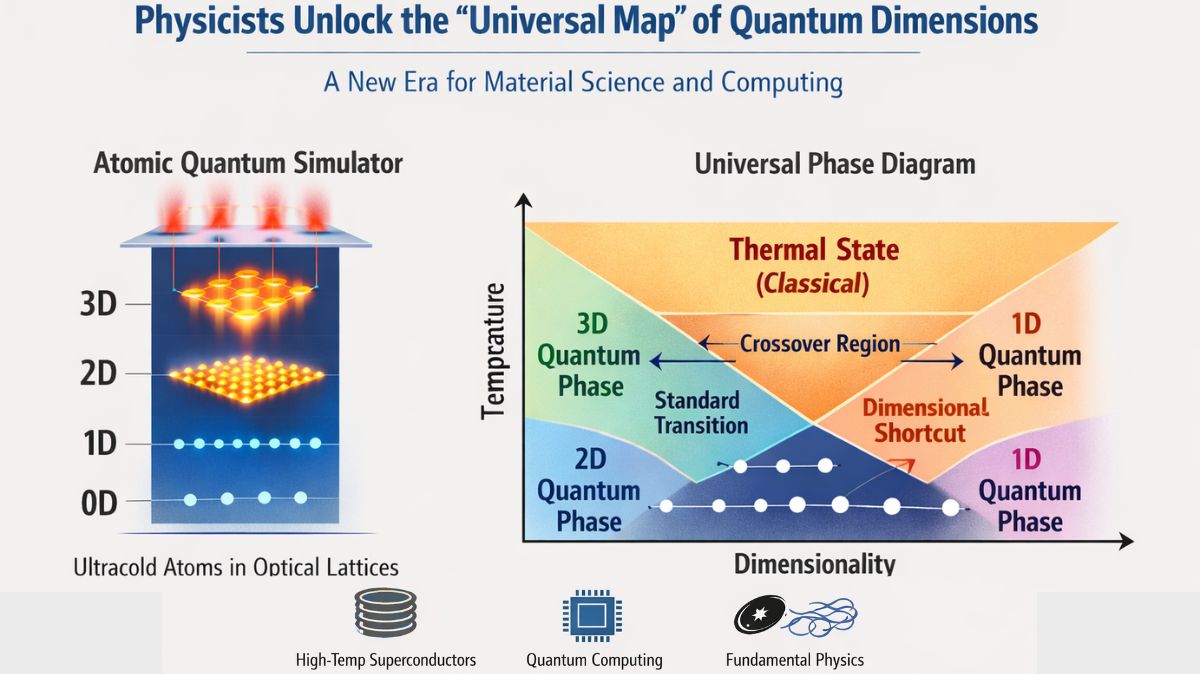
The development of a universal phase diagram is the study’s primary accomplishment. The researchers found distinct regimes for quantum 3D, 2D, 1D, and 0D physics at temperatures close to absolute zero. But as the temperature rose, the team discovered something shocking: between the quantum zero-dimensional and integer-dimensional states, a non-trivial “thermal regime” appeared.
The researchers discovered that a system’s initial dimensionality has a significant impact on the route it takes to reach this classical phase, which serves as a bridge between quantum states. Five different kinds of transitions from quantum to thermal states were found in the study:
- Standard Transitions: The direct heating of a 3D, 2D, or 1D quantum gas into a thermal gas.
- The “Dimensional Shortcut”: A particularly remarkable discovery in which a low-dimensional quantum domain (like 1D) must be crossed before a high-dimensional quantum system (like 3D) can enter a thermal phase.
The researchers showed that these transitions belong to particular universality classes, which are collections of various physical systems that share the same scaling behavior regardless of their microscopic features, rather than being random.
You can also read Arqit Quantum Inc Joins Tomorrow Street for Quantum Security
From Superconductors to Quantum Computers
This “field guide” to dimensionality has ramifications that go well beyond the confines of the lab. The study of superconductivity is one of the most important uses. The 2D-to-3D crossover is thought to be connected to the capacity of many high-temperature superconductors, which are “layered” materials, to conduct electricity without resistance. Scientists may eventually be able to build materials that continue to be superconducting at far higher temperatures by tracing this transition in a controlled simulator.
The paper offers a guide for safeguarding quantum states against decoherence, the “noise” that results in information loss in quantum computers. Hardware designers can now utilize this information to determine the ideal dimensionality for quantum processors to reduce fluctuations and improve stability because quantum fluctuations change with dimension.
Additionally, the paper discusses basic ideas in string theory and relativity, where the number of dimensions is frequently a variable. By studying matter in “unconventional dimensions,” scientists are learning more about the fundamental structure of the cosmos.
You can also read SBQuantum Company Oversubscribes $4 Million Seed Funding
A New Era of Precision Measurement
With this work, the area of quantum simulation undergoes a major transition from simple observation to precise measurement. These findings offer a “crucial foundation for understanding the projective condensed matter structures in unconventional dimensions,” according to the scientists’ publication.
The team has effectively overcome the computational obstacles that frequently impede even the most potent supercomputers in the world by simulating the behavior of complicated solids using light and atoms. The programmable atomic quantum simulator has shown itself to be an invaluable tool for testing and fine-tuning the rules of physics in real time.
This universal phase diagram will act as a permanent road map for the scientific community as it advances, directing the discovery of new phases of matter and opening the door to the next wave of quantum technology. The work was funded by a number of significant organizations, such as the Swiss National Science Foundation and the National Natural Science Foundation of China, demonstrating the international scope of this cooperative endeavor.
You can also read BTQ & Daou Data partner for Korean Quantum-secure Payments

Thank you for your Interest in Quantum Computer. Please Reply