Scientists Find a Novel “Topological Triplet Superconductor” in Magnetic Atom Chains
t-J Model
A group of physicists led by Francesca Ferlaino, Leonardo Bellinato Giacomelli, has presented a ground-breaking platform for delving into the secrets of quantum matter. Using ultracold magnetic lanthanide atoms, Erbium and Dysprosium, the researchers created a one-dimensional t-J model that supports a variety of odd quantum phases. The “topological triplet superconductor,” a rare matter situation with topological order and superconductivity, is their main discovery. This discovery opens a new path to understanding highly interacting fermionic systems, which have long pushed modern physics.
You can also read Q Factor Secures $24M To Solve Quantum Scaling Challenge
The t-J Model Paradigm
The Fermi-Hubbard model, which forms the basis of quantum simulation, must be examined to comprehend the importance of this study. The t-J Hamiltonian, which describes the intricate dynamics of fermions due to magnetic coupling, is frequently used to represent this in strong interaction regimes. This concept has historically only been experimentally realized for alkali atoms, where a sizable proportion of double occupancy cannot arise due to severe on-site repulsion.
The research team has, nonetheless, made significant progress beyond these present limitations. They created a t-J model with strong, anisotropic spin-spin interactions where the development of double occupancy is energetically enabled by utilizing the enormous magnetic moments of lanthanide atoms. Because of its adaptability, scientists are able to separate the intensity of spin-spin interactions from both the on-site interaction and the tunneling amplitude, which was previously not achievable with conventional alkali setups.
You can also read QuiX Quantum Leads in Photonic Quantum Error Mitigation
Lanthanides: The New Super-Tools
The special qualities of magnetic lanthanides like erbium and dysprosium are the key to this accomplishment. These atoms have an exceptionally high degree of tensorial polarizability and a vast spin manifold. The researchers successfully created an isolated spin-1/2 system by isolating and limiting the dynamics of the system to particular spin states through sophisticated spin-selective engineering of the quadratic light shift. Spin-flip operations are significantly enhanced, boosted by around two orders of magnitude, as a result of this decrease in spin space.
Phases of matter can arise without breaking the Mermin-Wagner theorem with this boost, which enables researchers to investigate regimes where the SU(2) spin-rotational symmetry is explicitly disrupted. The researchers demonstrated that their model is reliable and adaptable to several atomic species in an optical lattice by carefully calculating Hamiltonian parameters for both erbium and dysprosium.
A Map of Seven Quantum Worlds
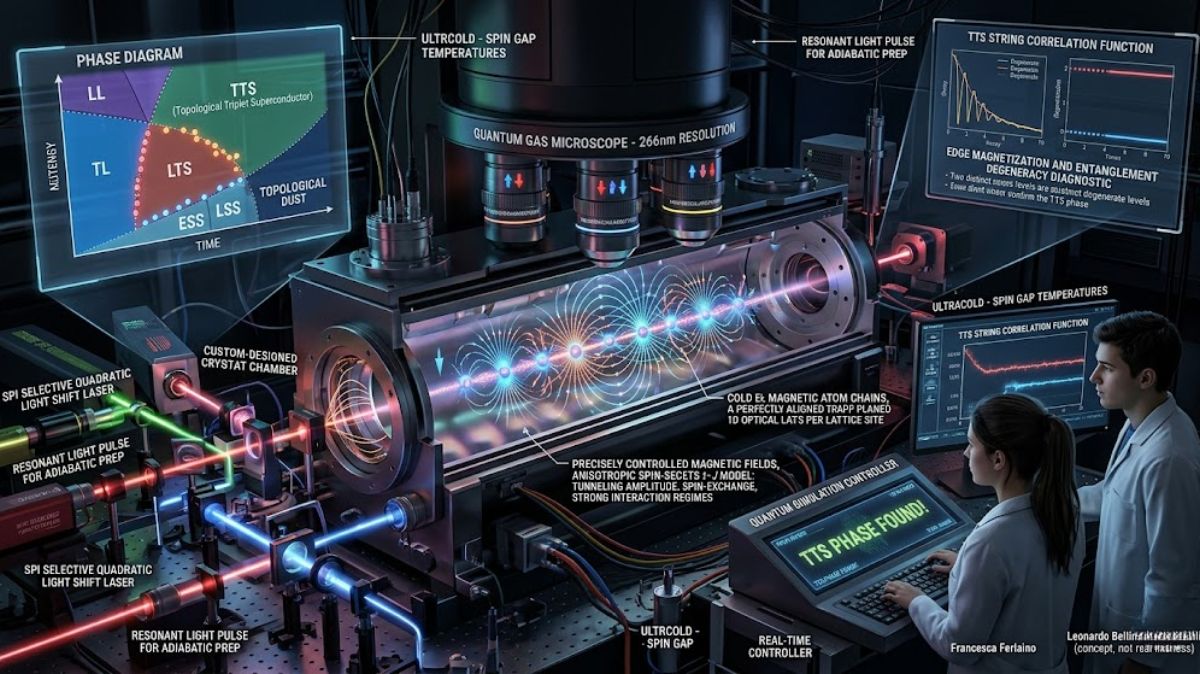
The group discovered a strikingly varied phase diagram by combining numerical Density-Matrix-Renormalization-Group (DMRG) research with analytical bosonization techniques. Seven separate stages were found in their investigation, each with its own special traits. These include the Luttinger Liquid (LL), the Topological Liquid (TL), and other types of superconductors, such as the Luttinger Triplet Superconductor (LTS), the Extended Singlet Superconductor (ESS), and the Local Singlet Superconductor (LSS). Bound pairs occupying two neighboring lattice sites create singlets in the ESS phase, a phenomena made possible by the system’s effective huge tunneling amplitude.
On the other hand, singlet pairs created by fermions occupying the same lattice site are present in the LSS phase. This special mechanism of on-site pairing is made possible by the combination of particular spin-flip interactions and attractive on-site energy. Because researchers may switch between different states by adjusting lattice depths and external magnetic fields, this phase landscape illustrates the remarkable versatility of the lanthanide platform.
You can also read Novera QPU Boosts Quantum Abilities at USask quanTA Center
The Topological Triplet Superconductor: The Greatest Accomplishment
The realization of the Topological Triplet Superconductor (TTS) is the most remarkable discovery. The TTS phase in this model is caused by competing interactions, in contrast to the well-known Kitaev chain model, where topological superconductivity results from material limitations. String order parameters indicate symmetry-protected topological order coexisting with dominating triplet superconducting correlations in this unusual state.
Using stringent diagnostics, such as edge magnetization and the even degeneracy of the entanglement spectrum, the scientists verified this. Strong spin-flip interactions and a tiny but finite number of doubly occupied sites are the driving forces for the genesis of TTS. Importantly, unlike the large Majorana fermions seen in other theories, the edge states in this triplet superconductivity are massless. This finding may make the experimental realization of a phase where the number of particles is rigorously preserved easier to achieve.
You can also read HPE leads Post-Quantum cybersecurity at RSA conference 2026
Building the Future: The Experimental Roadmap
The authors described a workable technique for state preparation and detection utilizing modern technology, demonstrating that the study goes beyond theory. They suggest employing spin-polarized fermions confined to a single layer of an anisotropic three-dimensional optical lattice to prepare these exotic phases. Researchers can get the desired density of about 0.5 atoms per site by adiabatically loading atoms and selectively deleting them from every second site using a resonant light pulse.
The method of detection will be “quantum gas microscopy,” which uses high numerical-aperture objectives to resolve individual lattice sites that are just 266 nanometers apart. In a single experimental run, sophisticated imaging techniques, possibly improved by deep learning or magnification, will enable the reconstruction of both spin and density at each lattice location. Detecting telltale edge states and string correlation functions that indicate the development of topological phases requires this site-resolved perspective.
You can also read IBM Quantum Computing News Advances Materials Science
Quantum Physics in a New Era
This approach creates a potent new path for investigating the most intriguing occurrences in contemporary physics. The group has paved the way for a better comprehension of superconductivity and topology by overcoming the temperature and interaction limitations of earlier models. All we need for our setup are temperatures below the spin gap, which can be achieved with sophisticated entropy control on existing experimental equipment. The scientific community is getting closer to understanding the “intriguing states of matter” that characterize highly interacting quantum systems as experimentalists start putting these procedures into practice.
You can also read IBM Illinois Collaboration Advances AI and Quantum Computing

Thank you for your Interest in Quantum Computer. Please Reply