Quantum Leap: Researchers Smash Coherence Records with 70-Second Atomic Superposition
BEC Bose Einstein Condensate
A group of multinational researchers produced a ground-breaking atom interferometer that can sustain a spatial superposition state for an astonishing 70 seconds in a historic accomplishment. The work, represents a major advancement in the capacity to use matter’s wave-like characteristics for incredibly accurate measurements, possibly revolutionizing everything from basic cosmology to mineral exploitation.
You can also read Inelastic Neutron Scattering and Future of Quantum Research
The Quantum Tightrope: Why Coherence Matters
This experiment employs superposition, a quantum particle’s two-state capacity. Ultracold atoms are divided into two wave packets by atom interferometry and move individually before recombining. The interference pattern shows small differences in forces like gravity or magnetic fields along certain paths.
Quantum states, however, are infamously brittle. Decoherence, in which the superposition collapses and the quantum “signal” is lost, is brought on by interactions with the surroundings or even atomic collisions. In the past, it has been extremely difficult to sustain this state for longer than a few seconds. Since the sensitivity of an interferometer is directly proportional to the amount of time the atoms spend in superposition, the discovery offers a far bigger window for measurements by extending this “hold time” to more than a minute.
You can also read BitsStrategy’s Quantum AI Trading App for Smarter Decisions
Engineering the “Perfect Silence”
The research team, which included scientists T. Petrucciani, A. Santoni, L. Pezzè, and M. Fattori, used a “full-stack” approach to quantum control to make this accomplishment. The experiment began with a Bose-Einstein Condensate (BEC), a state of matter in which atoms are chilled to virtually absolute zero and act as only one quantum entity.
The use of “non-interacting” atoms was a significant innovation. Atoms in a BEC typically collide and interact, introducing “noise” and causing the quantum state to dephase quickly. By employing Feshbach resonances, a method that uses external magnetic fields to adjust the strength of atom-to-atom interaction, the team was able to “turn off” these internal collisions.
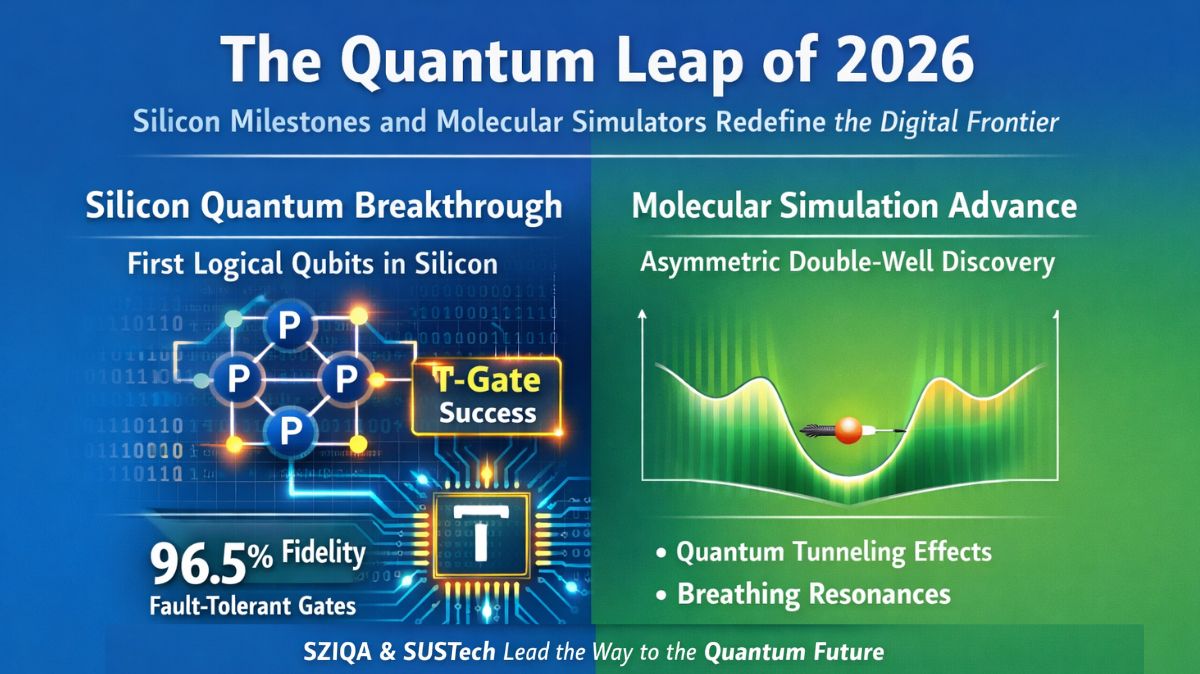
The researchers used quantum tunneling to achieve coherent beam splitting by trapping the BECs in a novel array of double-well potentials. Additionally, rather of being free to fall, the atoms were contained in a sophisticated optical trap. The researchers were able to examine the boundaries of coherence resulting from “collective dephasing” because of this constraint. Their investigation produced an unexpected and encouraging result: whenever hold times beyond tens of seconds, the rate of decoherence actually slows down considerably, indicating that much longer durations might be achievable with additional refinement.
You can also read Signal To Noise Ratio SNR: Is End Of Noise Floor Problem?
Suppreessing Noise with Spin-Echo Protocols
Additionally, the researchers used many parallel Mach-Zehnder interferometers to resolve external instabilities. They were able to create a trapped-atom gradiometer by using differential analysis to suppress common-mode potential instabilities. The scientists used a spin-echo strategy to further battle decoherence, suppressing new noise sources and moving the system closer to the one-minute coherence milestone.
Quantum metrology, the science of high-precision measurement, depends on this degree of control. The researchers intend to attain sub-shot-noise sensitivity a threshold where the sensor’s accuracy is no longer constrained by the randomness of individual atoms by linearizing the manipulation of quantum entangled states.
Applications: From Deep Earth to New Physics
A coherence window of 70 seconds has significant ramifications. Quantum gravimetry measures Earth’s gravity and provides instant benefits. This precision allows geodesy and resource study to clearly see underground structures, water table variations, and mineral deposits.
Beyond useful earth sciences, the technology examines the universe’s fundamental structure:
- Searching for the “Fifth Force”: Many hypotheses propose the presence of a “fifth force” in addition to the four fundamental forces recognized by conventional physics. Long-duration interferometry’s exceptional sensitivity might pick up on the minute variations that such a push would produce.
- Probing Quantum Gravity: How to reconcile gravity with quantum mechanics is one of the biggest challenges in contemporary science. Keeping massive “Schrödinger’s cat” states of atom clouds in superposition for long durations lets physicists find gravity-induced decoherence.
- Sub-micron Spatial Resolution: Trapped BECs allow precise force measurements, which is vital for studying Casimir-Polder forces and atom-surface interactions.
You can also read Quantum Security News: The Global Race to Stay Protected
The Path to a Quantum Economy
This development is consistent with a larger worldwide trend toward the commercialization of quantum technologies. The researchers pointed out that the next generation of scalable quantum processors is quite compatible with their use of neutral-atom platforms. The capacity to preserve stability and coherence becomes the essential criterion for commercial success once quantum sensors leave the lab.
The Italian Ministry of Universities and Research and the European Union’s Horizon 2020 Program gave the research substantial support, demonstrating the strategic significance of quantum sensing in the contemporary technological environment. The National Institute of Optics (CNR-INO), the University of Florence, and the European Laboratory for Nonlinear Spectroscopy (LENS) are among the esteemed institutions that collaborated to produce the authors.
You can also read ParityQC Sets Record with 52-Qubit Quantum Fourier Transform
The Road Ahead
The researchers think the ceiling is substantially higher even though a 70-second coherence time is a record-breaking achievement. Subsequent experiments will probably concentrate on more advanced potential shape control and matter-wave collimation to even lower energies, in the picokelvin region.
These sensors will change from being instruments of laboratory research to the foundation of a new “quantum economy” when they gain stability. In this future, it would be possible to map the universe’s secret forces and the delicate waves of gravity just as easily as a use GPS to traverse the modern world. For the time being, the capacity to keep a quantum system “alive” for more than a minute is evidence of human control over the coldest and most fragile aspects of nature.
You can also read UConn MSBAPM Students Win At QuantumUP! Hackathon 2026
Thank you for your Interest in Quantum Computer. Please Reply