Overview
Using a quadratic coupling between a two-level qubit and a bosonic oscillator, this study presents a deterministic strategy for creating certain quantum states. The authors show how to create superpositions of orthogonally compressed vacuum states, which form the basis of sophisticated quantum error correction, by meticulously adjusting an external drive. These states are suggested as logical qubits that can detect phase faults and single-boson losses, especially in the high squeezing limit.
In particular, the paper emphasizes the promise of superconducting circuits and electromechanical systems, where mechanical modes are perfect for quantum memory due to their low decoherence rates. As long as the qubit’s decoherence stays below reasonable limitations, numerical analysis further demonstrates that this state preparation is resilient in empirically relevant settings. In the end, the study closes the gap between the actual needs for fault-tolerant quantum information processing and theoretical state engineering.
A Novel Protocol for Fault-Tolerant Quantum Computing
Extreme fragility of quantum information continues to be the fundamental obstacle in the global race to construct a working, large-scale quantum computer. Superposition and entanglement regulate quantum states, which are infamously prone to “decoherence”—the loss of information brought on by interaction with the outside world. However, a recent study discovery has put forth a deterministic protocol that uses mechanical oscillators and qubits’ quadratic coupling to produce a strong new class of quantum error-correcting codes.
The Search for Fault Tolerance
From secure communications to material research and medical development, modern quantum technology seeks to transform these domains. To do this, scientists are working on “fault-tolerant” quantum computation, in which mistakes are fixed more quickly than they arise. Bosonic quantum error correction (bQEC), in which information is encoded into several energy levels of a bosonic mode, such a microwave cavity or a mechanical resonator, as opposed to a single two-level system, is one of the most promising approaches.
The “break-even point,” at which the repaired system outlasts its component parts, has been reached by bQEC, according to recent milestones. The capacity to create certain, high-fidelity quantum states, like the well-known Gottesman-Kitaev-Preskill (GKP) states, is essential to these achievements. Another powerful tool, squeezed vacuum states, is currently the focus of an approach given by researchers.
The Squeezing Power
The term “squeezing” in the context of quantum mechanics describes a procedure that directly applies the Heisenberg Uncertainty Principle by lowering the uncertainty (noise) in one of a system’s properties at the cost of raising another.
In contrast to earlier techniques that depended on linear interactions, this new method makes use of a high quadratic coupling. Some electromechanical systems, such as a Cooper-pair box coupled to a mechanical oscillator or a nanopillar connected to a superconducting circuit, are “native” to this kind of interaction. By successfully isolating the qubit and the mechanical resonator while they are not in use, these topologies have the significant advantage of protecting the system from decoherence.
A Mechanical Benefit
Although the operating speed of superconducting circuits (circuit QED) is well-known, they frequently have quite large decoherence rates. On the other hand, mechanical components have very low decoherence rates, which makes them perfect for long-term quantum memory. The researchers point out that even in the face of ambient noise, the device can maintain quantum information with great fidelity by employing a mechanical oscillator.
Applying a certain harmonic drive to the qubit is how the suggested protocol operates. To provide controlled squeezing, the researchers may create “sideband transitions” by precisely adjusting the drive’s frequency and amplitude, such that the drive frequency matches the mechanical frequency. The driving amplitude must be adjusted to the first root of a mathematical function called the Bessel function (J0), which removes undesired energy changes and concentrates the interaction only on compressing the mechanical state. This was a crucial technical need that was found.
You can also read RoNaQCI: Romania’s Quantum Network by IonQ & ID Quantique
Developing Better Code
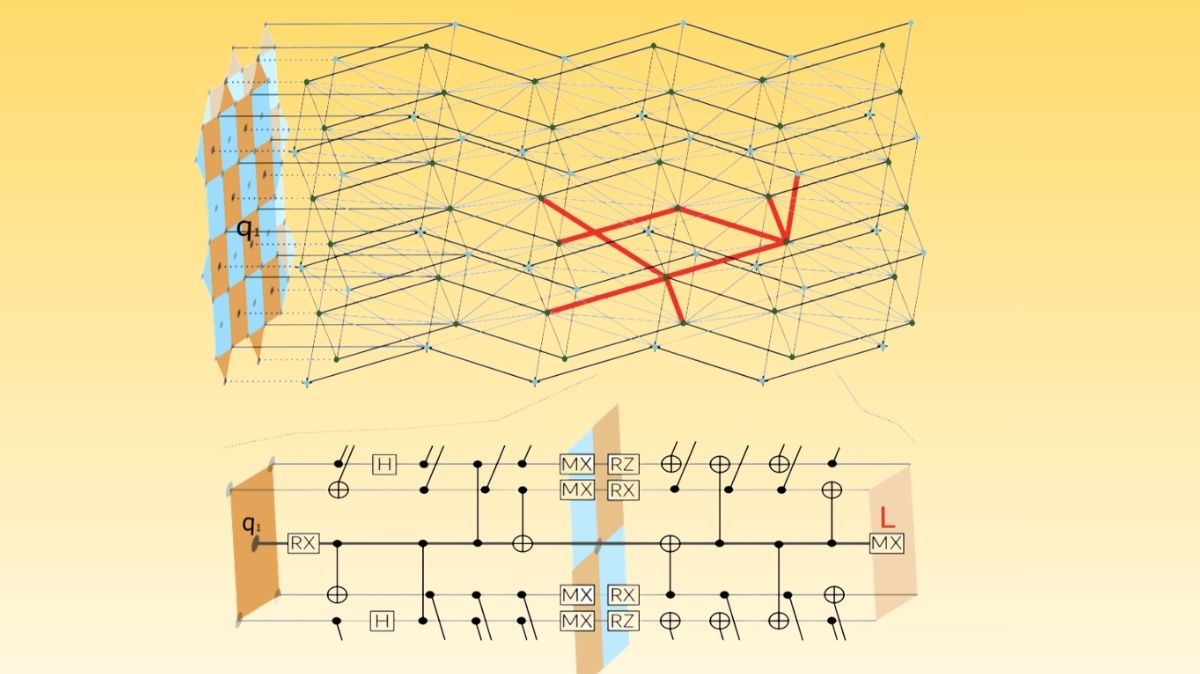
The use of this state preparation as a quantum code is the ultimate objective. The researchers have developed a new logical qubit by constructing superpositions of states compressed along orthogonal axes. The work shows that this “squeezed vacuum code” can guard against typical mistakes such as the loss of a single boson or “dephasing” (the loss of quantum phase information) using the Knill-Laflamme criteria, the mathematical gold standard for error correction.
These states are indistinguishable from perfect “number-phase codes,” which are theoretically able to detect even small changes in the energy or phase of a system, in the limit of enormous squeezing. The relative simplicity of preparation in mechanical systems may make this code a more viable option for future technology, even if the researchers admit that it presently has a larger “phase uncertainty” than some other existing approaches like cat codes or binomial codes.
You can also read Kvantify Qrunch on Amazon Braket advances quantum chemistry
Experimental Realities
The researchers recreated the system under authentic experimental settings to assess the protocol’s viability. They looked at a superconducting qubit at 4 GHz connected to a mechanical oscillator pulsating at 150 MHz. The decoherence of the superconducting qubit itself, rather than the mechanical resonator, is the main barrier for the technology at temperatures as low as 10 milli-Kelvin.
According to their results, high-fidelity state preparation is possible as long as the decay and dephasing rates of the qubit stay below the coupling strength (about 15 kHz in their model). Current laboratory technology can easily achieve these values, indicating that “squeezed” mechanical qubits may soon be a reality in the upcoming generation of quantum processors.
In conclusion
The science of quantum acoustics has advanced significantly with the invention of a deterministic methodology for creating squeezed vacuum superpositions. Researchers are paving the way for reliable, error-corrected quantum computing by converting the mechanical vibrations of small objects into high-fidelity logical qubits. Moving from the lab to the real world may need the capacity to “squeeze” every last bit of performance out of quantum systems as platforms continue to advance.
You can also read Qilimanjaro Tech Expands Quantum-AI Research with Q-AINA
Thank you for your Interest in Quantum Computer. Please Reply